

Introduction: Why Ethical Hacking Is a Top Career Choice in 2026
Cyberattacks are no longer rare events — they are happening every minute, targeting individuals, startups, enterprises, and even governments. As we move into 2026, the digital world is expanding faster than ever with cloud computing, AI, fintech apps, online education, and remote work. With this growth comes a massive rise in cyber threats.
This is exactly where ethical hacking comes in.
Ethical hacking has emerged as one of the most in-demand and future-proof careers in cybersecurity. Organizations today don’t just want IT professionals — they want skilled ethical hackers who can think like attackers and protect systems before real hackers exploit them.
If you are:
A beginner with no IT background
A student confused about career options
A working professional planning a career switch
Someone curious about bug bounty and cybersecurity
👉 This guide is written for you.
In this complete Ethical Hacking Career Guide 2026, you’ll learn:
What ethical hacking really is (in simple terms)
Whether ethical hacking is a good career in 2026
Skills required to become an ethical hacker
A clear step-by-step ethical hacking roadmap
Ethical hacker salary in India and globally
Certifications, job roles, and common beginner mistakes
No hype. No false promises. Just realistic guidance designed especially for beginners and non-IT learners.
What Is Ethical Hacking? (Explained for Beginners)
Ethical hacking means legally testing computer systems, websites, networks, and applications to find security weaknesses before criminals do.
An ethical hacker uses the same techniques and tools as malicious hackers, but with permission and legal approval. The goal is not to cause harm, but to improve security.
Ethical Hacker vs Malicious Hacker
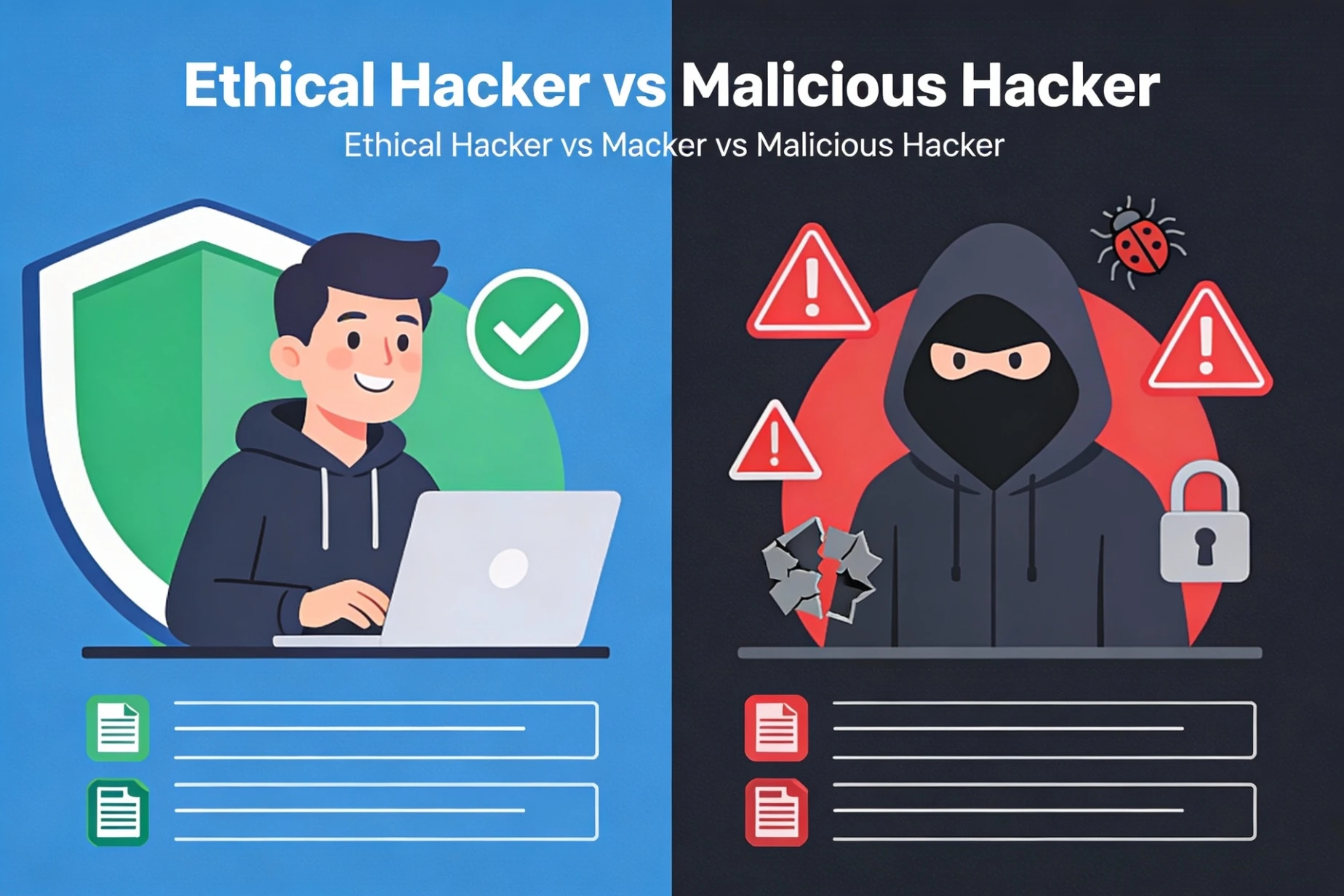
Let’s simplify this:
| Malicious Hacker | Ethical Hacker |
|---|---|
| Hacks illegally | Hacks with permission |
| Steals data | Protects data |
| Causes damage | Prevents damage |
| Breaks the law | Works within the law |
Ethical hackers are often hired by:
IT companies
Banks & financial institutions
Startups & SaaS companies
Government organizations
Security firms
Their job is to find vulnerabilities, report them responsibly, and help fix them before attackers exploit them.
What Does an Ethical Hacker Actually Do?
An ethical hacker’s daily work may include:
Testing websites for security flaws
Finding vulnerabilities in applications
Checking network security
Simulating real cyberattacks
Writing detailed security reports
Helping developers fix security issues
In simple words:
Ethical hackers break systems to make them stronger.
Is Ethical Hacking Legal?
Yes — ethical hacking is completely legal when done with proper authorization.
This is one of the biggest misconceptions beginners have. Learning ethical hacking, practicing in labs, participating in bug bounty programs, and working as a penetration tester are 100% legal.
Illegal hacking only happens when someone attacks systems without permission.
Why Ethical Hacking Matters More in 2026
In 2026, cybersecurity threats are more advanced due to:
AI-powered cyberattacks
Cloud infrastructure vulnerabilities
Remote work environments
Online payment systems
IoT and smart devices
Because of this, companies are shifting from reactive security to proactive security, and ethical hackers are at the center of this shift.
This is why ethical hacking is not just a job — it’s a critical skill for the digital future.
🔎 People Also Ask: Ethical Hacking Career Questions
Is ethical hacking hard for beginners?
Ethical hacking can feel challenging at first, but beginners who follow a structured roadmap and practice regularly can learn it successfully.
Is ethical hacking a high-paying job?
Yes. Ethical hacking is considered a high-paying cybersecurity role, especially for professionals with practical skills and experience.
Can I learn ethical hacking after 12th?
Yes. Students can start learning ethical hacking after 12th by focusing on computer basics, networking, and security fundamentals.
Is ethical hacking better than software development?
Ethical hacking and software development are different career paths. Ethical hacking focuses on security testing, while development focuses on building applications.
Is Ethical Hacking a Good Career in 2026?

This is one of the most searched questions by beginners — and the short answer is:
Yes, ethical hacking is an excellent career choice in 2026, if you learn it the right way.
Why Ethical Hacking Is in High Demand in 2026
Cybersecurity is no longer optional. Every organization that uses technology needs protection.
In 2026, demand for ethical hackers is increasing due to:
Rapid digital transformation
Growth of cloud platforms and SaaS applications
AI-powered cyberattacks
Remote work and distributed systems
Strict data protection laws
Companies don’t wait for hackers to attack anymore — they hire ethical hackers to find weaknesses in advance.
According to industry trends, cybersecurity roles are among the fastest-growing tech jobs globally, and ethical hacking sits at the core of this demand.
Ethical Hacking vs Traditional IT Careers
Many beginners ask whether ethical hacking is better than regular IT jobs like software development or system administration.
Here’s a simple comparison:
| Aspect | Ethical Hacking | Traditional IT |
|---|---|---|
| Entry barrier | Skill-based | Degree-focused |
| Learning style | Practical & hands-on | Theory + tools |
| Job demand | Very high | Competitive |
| Freelancing | Possible | Limited |
| Bug bounty | Yes | No |
Ethical hacking focuses more on skills and mindset than degrees, which makes it attractive for non-IT backgrounds.
Future Scope of Ethical Hacking
Ethical hacking is evolving with technology. In 2026 and beyond, ethical hackers are needed in:
Cloud security
Web & API security
AI & ML systems
Mobile application security
IoT security
This means ethical hacking is not a short-term trend, but a long-term career path with multiple specialization options.
Myths vs Reality About Ethical Hacking
Let’s clear some common myths:
❌ Myth: Ethical hacking is illegal
✅ Reality: It is legal with permission
❌ Myth: You need advanced coding skills
✅ Reality: Basics are enough to start
❌ Myth: You can become an ethical hacker in 30 days
✅ Reality: It requires consistent learning and practice
❌ Myth: Only IT students can succeed
✅ Reality: Many ethical hackers come from non-IT backgrounds
Who Should Choose Ethical Hacking as a Career?
Ethical hacking is ideal if you:
Enjoy problem-solving
Like understanding how things work
Are curious about security and technology
Prefer hands-on learning
Want a future-proof tech career
If you are looking for quick money or shortcuts, ethical hacking is not for you.
But if you are ready to learn, practice, and grow, it’s one of the best careers in 2026.
Who Can Become an Ethical Hacker? (Non-IT Friendly Guide)

One of the biggest advantages of ethical hacking is that anyone can start, regardless of background.
Can Non-IT Students Learn Ethical Hacking?
Yes.
You do not need an IT degree or computer science background to start ethical hacking.
What you actually need:
Basic computer knowledge
Willingness to learn
Consistent practice
Ethical mindset
Many successful ethical hackers started as:
Commerce students
Arts students
Mechanical / civil engineers
Self-taught learners
Educational Requirements (The Truth)
Let’s be honest.
You do not need:
A computer science degree
Expensive college education
Advanced mathematics
You do need:
Understanding of basics (networking, OS)
Hands-on practice
Logical thinking
Real-world exposure through labs
Degrees may help in corporate jobs, but skills matter more than certificates in ethical hacking.
Can You Start Ethical Hacking After 12th or Graduation?
Absolutely.
You can start ethical hacking:
After 12th class
During college
After graduation
Even while working a full-time job
The earlier you start learning, the better your advantage in the long run.
Is There Any Age Limit?
No.
Ethical hacking has no age limit.
What matters is:
Learning speed
Dedication
Practice consistency
Many people successfully switch to ethical hacking in their late 20s or 30s.
Backgrounds That Do Well in Ethical Hacking
People who often excel in ethical hacking:
Curious learners
Gamers and puzzle-solvers
People who enjoy research
Self-learners
Those who like experimenting
If you can learn step by step and practice regularly, background doesn’t matter.
Skills Required for Ethical Hacking in 2026
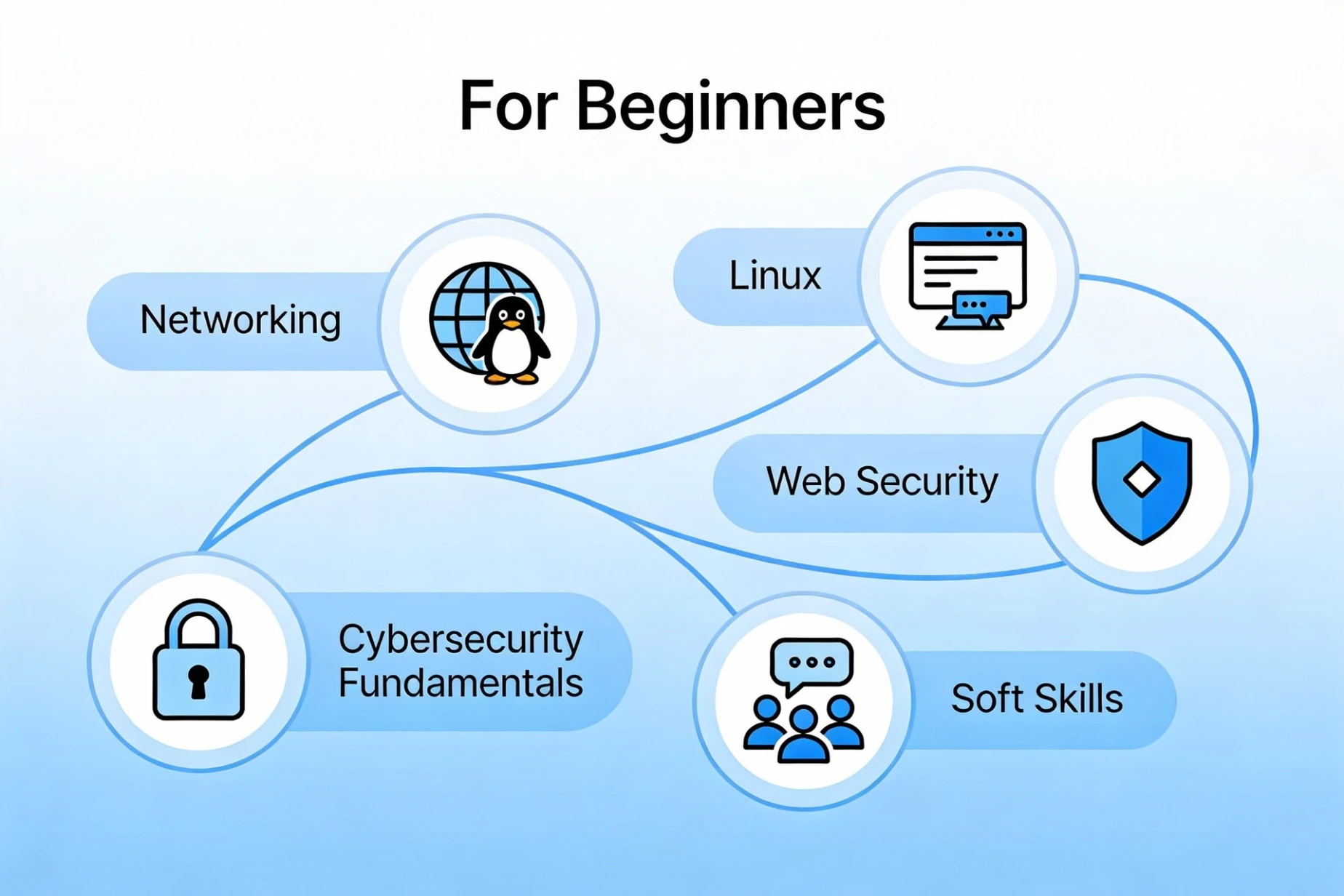
One of the biggest fears beginners have is:
“Do I need to learn everything before starting ethical hacking?”
The answer is NO.
Ethical hacking is a skill-based career, and you don’t need to master everything at once. You need the right skills, in the right order.
Let’s break this down simply.
Technical Skills You Need (Beginner Level)
These are foundational skills. You don’t need expert-level knowledge — just clear basics.
1. Computer & Operating System Basics
How computers work
Difference between Windows and Linux
File systems, processes, permissions
👉 Linux is especially important because most hacking tools run on Linux.
2. Networking Fundamentals
You must understand:
What is an IP address
What is DNS, HTTP/HTTPS
What is a router, firewall, ports
How data travels over the internet
You don’t need CCNA-level depth — just concept clarity.
3. Basic Web Technologies
Ethical hackers test websites, so you should know:
How websites work
Basics of HTML, CSS
Very basic JavaScript understanding
👉 You don’t need to become a web developer.
Ethical Hacking–Specific Skills
These are the core hacking-related skills you’ll build step by step.
1. Understanding Vulnerabilities
What is a vulnerability?
What is exploitation?
Why misconfigurations happen
Examples:
Weak passwords
Insecure login pages
Poor access controls
2. Web Application Security
This is the most important area for beginners in 2026.
You’ll learn about:
SQL Injection
Cross-Site Scripting (XSS)
Authentication issues
Authorization flaws
Most real-world attacks happen at the web application level.
3. Hands-On Practice with Labs
Ethical hacking is not theory-based.
You must practice on:
Legal labs
Vulnerable machines
Simulated environments
Practice teaches you:
How attacks really work
How to think like an attacker
How to troubleshoot mistakes
Do You Need Coding for Ethical Hacking?
This is a very common question.
Short answer:
👉 Basic coding knowledge is enough to start.
You do NOT need:
Advanced programming
Data structures
Competitive coding skills
Helpful languages (later, not mandatory at start):
Python (automation)
JavaScript (web security)
Bash (Linux scripting)
Soft Skills (Most Beginners Ignore These)
These skills often decide success more than tools.
Curiosity & patience
Problem-solving mindset
Attention to detail
Documentation & reporting
Ethical thinking & responsibility
Ethical hacking is about thinking, not just tools.
Ethical Hacking Roadmap 2026 (Step-by-Step for Beginners)
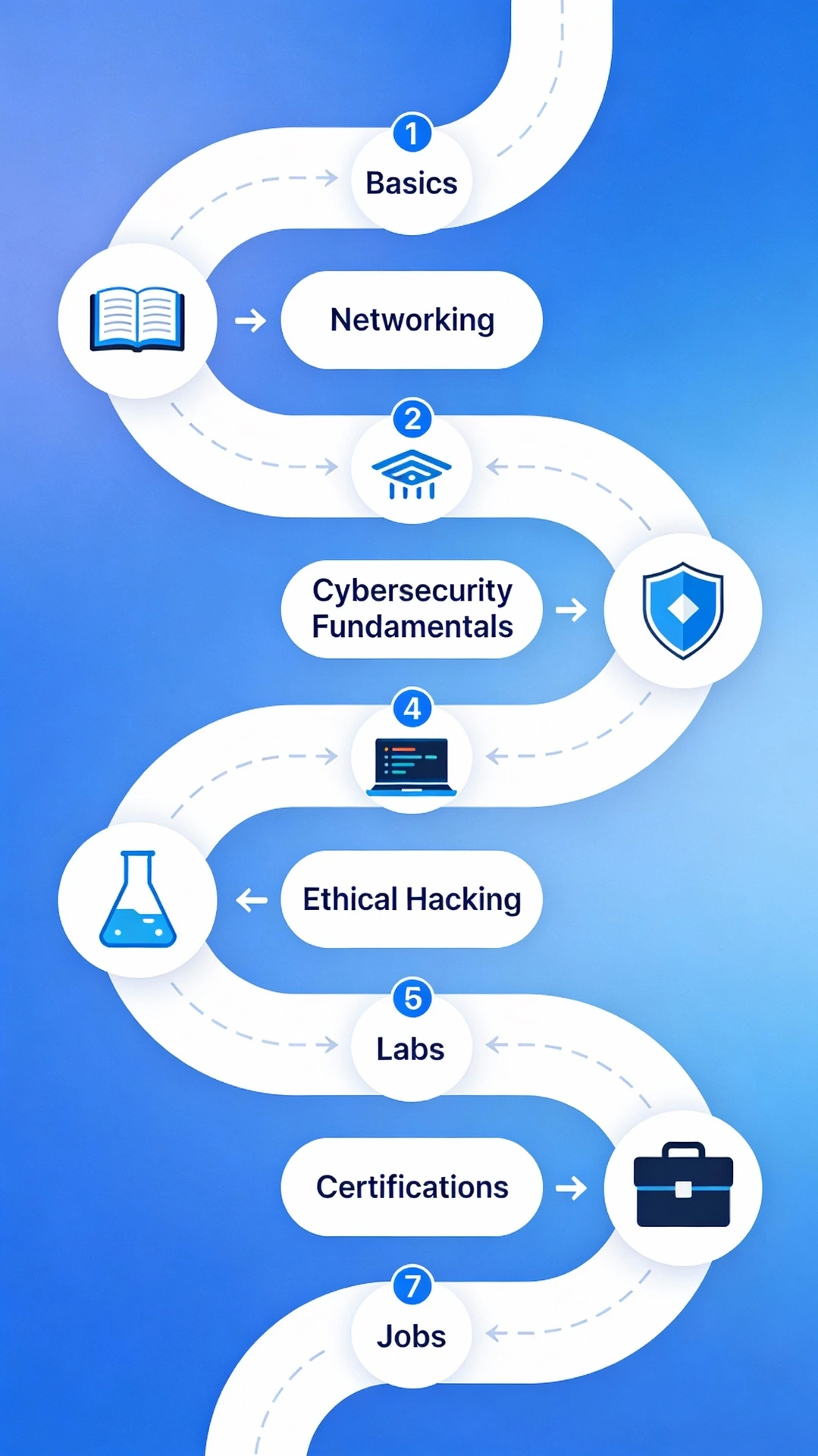
This is the most important section for beginners.
Follow this roadmap in order — don’t skip steps.
Step 1: Learn Computer & Networking Basics
Start with:
How computers work
Operating systems (Windows + Linux)
Basic networking concepts
⏱️ Time required: 3–4 weeks
👉 This builds your foundation and prevents confusion later.
Step 2: Understand Cybersecurity Fundamentals
Before hacking, you must understand security concepts:
What is cybersecurity?
Threats, vulnerabilities, risks
How attackers think
How defenses work
Key concepts:
CIA Triad (Confidentiality, Integrity, Availability)
Types of attacks
Security controls
⏱️ Time required: 2–3 weeks
Step 3: Start Ethical Hacking (Beginner Level)
Now you officially enter ethical hacking.
You should focus on:
Web application security
Common vulnerabilities
How attacks happen
How to test legally
This stage is about:
Learning concepts
Applying them in labs
Making mistakes and fixing them
⏱️ Time required: 2–3 months
Step 4: Practice on Labs & Realistic Scenarios
This is where most beginners fail — because they don’t practice enough.
You should:
Solve vulnerable machines
Practice real-world scenarios
Repeat attacks until you understand them
Remember:
Tools don’t make you a hacker — practice does.
⏱️ Time required: ongoing
Step 5: Beginner-Friendly Certifications (Optional)
Certifications are not mandatory, but they help beginners:
Stay structured
Build confidence
Improve job chances
Best used as:
Learning guidance
Resume booster (not skill replacement)
We’ll cover certifications in detail in the next section.
Step 6: Build Proof of Skills (Very Important)
Instead of saying “I know ethical hacking”, show it.
Examples:
Completed labs
Writeups (legal only)
Bug bounty reports
Projects & case studies
This is what employers and clients care about.
Step 7: Jobs, Internships & Bug Bounty
Once you have basics + practice:
Apply for entry-level roles
Look for internships
Explore bug bounty programs
Start freelancing (small tasks)
Ethical hacking careers don’t start with “expert” roles — they start with consistent effort.
Ethical Hacking Certifications for Beginners (2026)
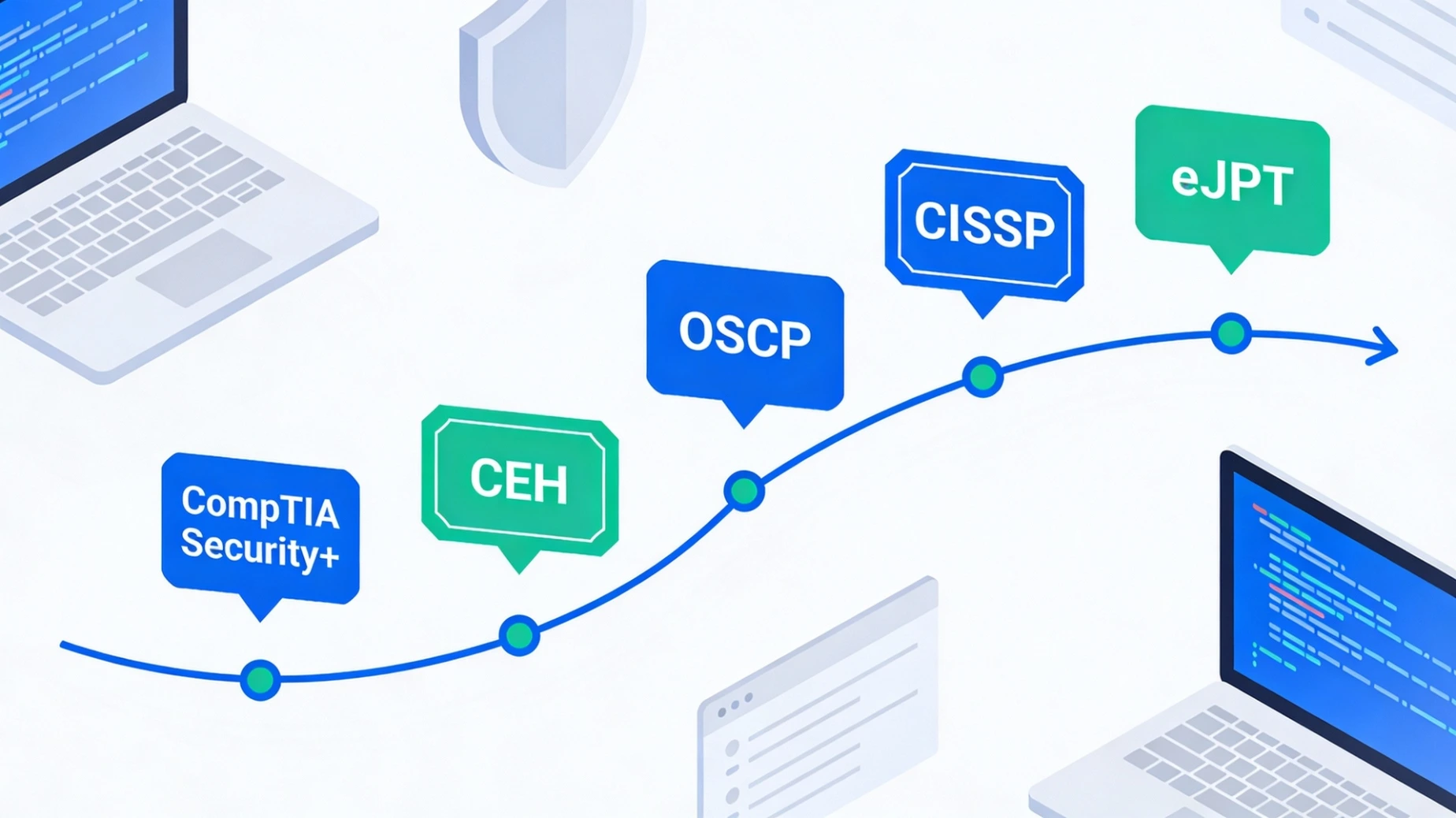
Certifications are one of the most confusing topics for beginners in ethical hacking.
Some people say:
“Certifications are useless”
Others say:
“Without certifications, you’ll never get a job”
👉 The truth is in between.
Are Certifications Mandatory for Ethical Hacking?
No, certifications are NOT mandatory to learn ethical hacking.
However, for beginners and non-IT backgrounds, certifications can be very helpful because they:
Provide a structured learning path
Build confidence
Improve resume shortlisting
Help in entry-level jobs
Certifications should support your skills, not replace them.
Beginner-Friendly Ethical Hacking Certifications (2026)
If you are just starting, focus on foundational and beginner-level certifications.
1. CEH (Certified Ethical Hacker – Beginner Track)
Covers basics of ethical hacking
Recognized globally
Good for understanding concepts
👉 Best for: Beginners who want structured learning + recognition
2. eJPT (Entry-Level Penetration Tester)
More hands-on focused
Practical lab-based approach
Teaches real-world skills
👉 Best for: Learners who want practice-first learning
3. Security+ (Cybersecurity Fundamentals)
Not hacking-specific
Strong security fundamentals
Good foundation for beginners
👉 Best for: Non-IT learners entering cybersecurity
Certification vs Skills: What Matters More?
Let’s be clear:
| Factor | Importance |
|---|---|
| Hands-on practice | ⭐⭐⭐⭐⭐ |
| Real-world understanding | ⭐⭐⭐⭐⭐ |
| Problem-solving | ⭐⭐⭐⭐ |
| Certifications | ⭐⭐⭐ |
If you have certificates but no practical skills, you will struggle.
If you have skills but no certificates, you can still succeed — especially in bug bounty and freelance paths.
👉 Best approach:
Learn skills → practice → then pursue certifications.
When Should You Do Certifications?
❌ Not before learning basics
❌ Not without hands-on practice
✅ After understanding core concepts
✅ When you want job validation
Certifications are a tool, not a shortcut.
Ethical Hacker Salary in India & Globally (2026)
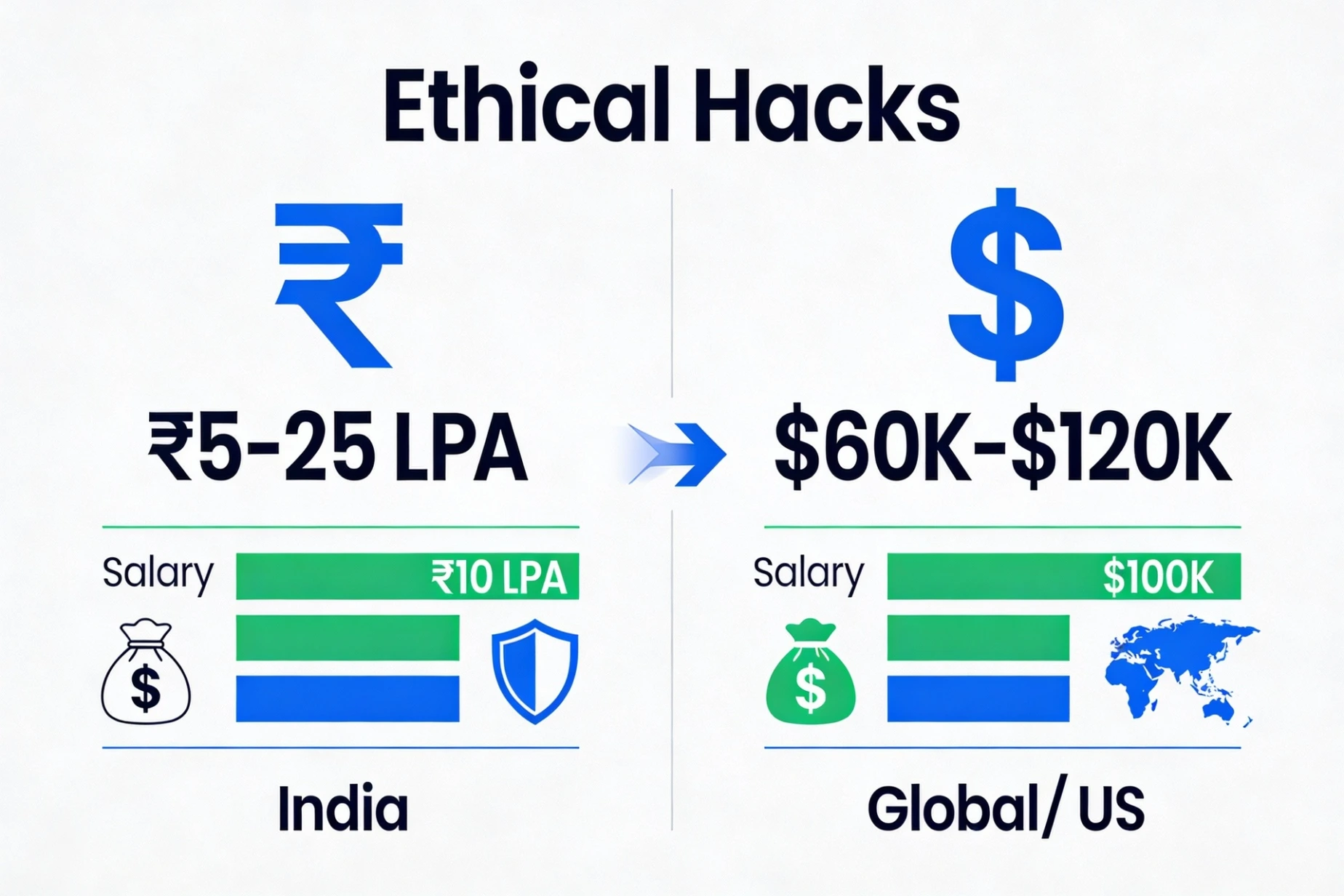
Salary is an important factor — but it should be understood realistically, especially for beginners.
Let’s break it down honestly.
Ethical Hacker Salary in India (2026)
Entry-Level / Fresher
₹4 LPA – ₹8 LPA
Depends on skills, internships, labs, and certifications
Mid-Level (2–4 Years Experience)
₹10 LPA – ₹18 LPA
Strong demand for skilled professionals
Senior Ethical Hacker / Pentester
₹20 LPA – ₹40+ LPA
Specialized roles pay more
👉 Salaries vary based on skills, company, and location.
Ethical Hacker Salary Globally (2026)
United States
$90,000 – $140,000 per year
High demand + strong cybersecurity laws
Europe
€60,000 – €100,000 per year
Growing security investments
Remote Jobs
Global companies hiring remote ethical hackers
Skill-based hiring is increasing
Bug Bounty Earnings (Bonus Income)
Bug bounty is not guaranteed income, but it can be powerful.
Beginners: $0 – $500/month (learning phase)
Intermediate: $1,000 – $5,000/month
Experts: Much higher (project-based)
Many ethical hackers use bug bounty as:
Side income
Skill proof
Experience builder
Factors That Affect Ethical Hacker Salary
Your salary depends on:
Skill depth
Practical experience
Certifications
Communication & reporting skills
Specialization (web, cloud, mobile)
👉 Tools don’t increase salary — skills do.
Ethical Hacking Job Roles You Can Target in 2026
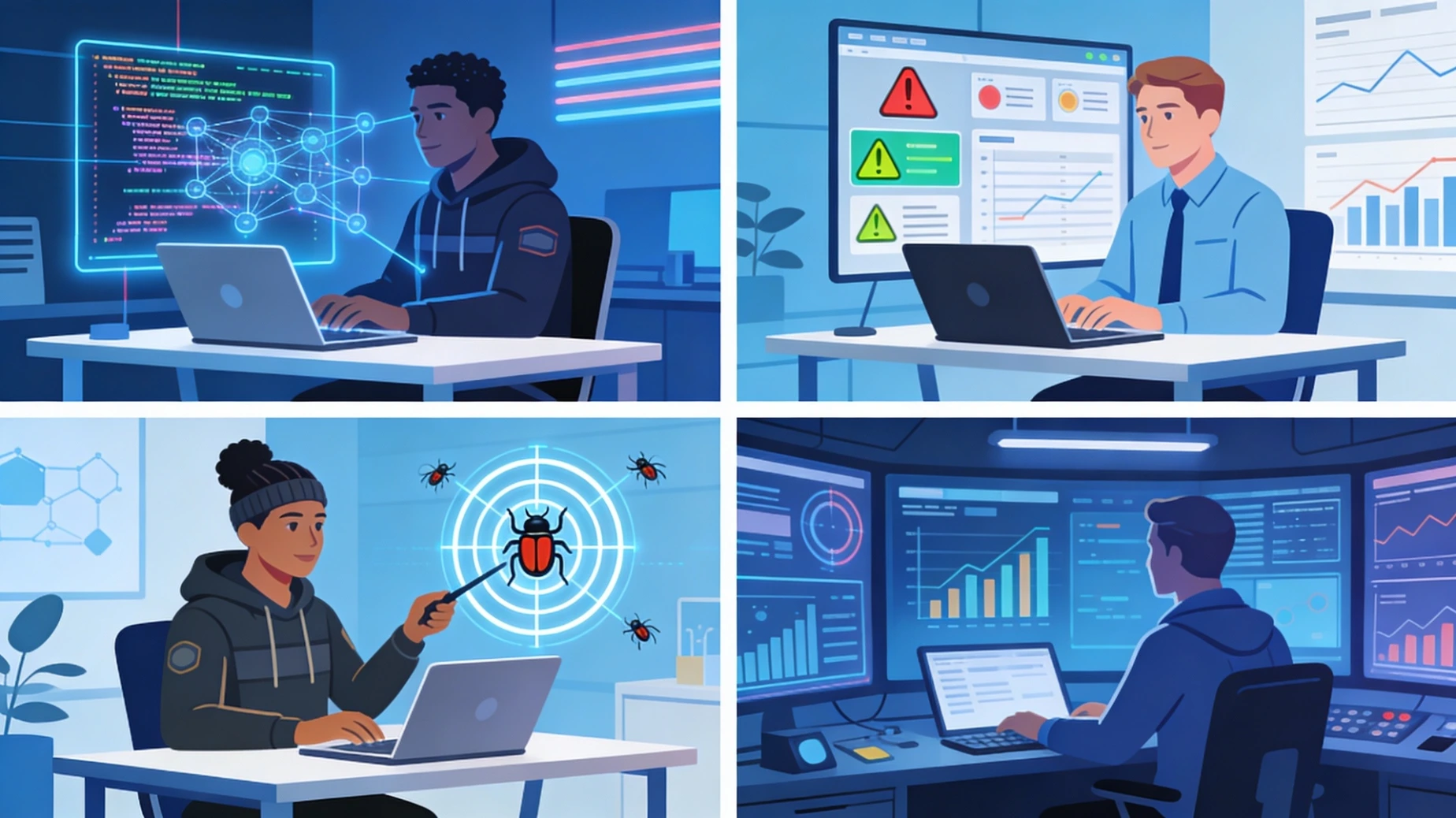
Ethical hacking is not a single job title. As you gain skills, you can move into multiple cybersecurity roles.
1. Ethical Hacker / Penetration Tester
Tests systems, networks, and applications
Finds and reports vulnerabilities
Works with security teams
👉 Most common role after learning ethical hacking
2. Security Analyst (Beginner-Friendly)
Monitors security incidents
Analyzes threats and alerts
Works in SOC teams
👉 Good entry point for beginners
3. Bug Bounty Hunter
Finds vulnerabilities in real-world websites
Reports bugs legally
Gets paid per valid bug
👉 Skill-based, flexible, but competitive
4. SOC Analyst
Handles security operations
Monitors logs and incidents
Works in shifts
👉 Good for beginners who want structured roles
5. Freelance Security Tester
Works on short-term projects
Tests websites and applications
Requires strong reporting skills
Common Mistakes Beginners Make in Ethical Hacking

Avoiding these mistakes can save months of frustration.
1. Skipping Basics
Jumping into tools without understanding networking or OS concepts.
2. Tool Obsession
Thinking tools make you a hacker — they don’t.
3. Practicing on Illegal Targets
This can ruin your career before it starts.
4. No Hands-On Practice
Watching videos without applying knowledge.
5. Chasing Certificates Blindly
Certificates without skills don’t help.
How Long Does It Take to Become an Ethical Hacker?
This depends on time, consistency, and practice.
3 months: Basic understanding
6 months: Beginner-level confidence
12 months: Job-ready (with practice)
Ethical hacking is a marathon, not a sprint.
Founder’s Note – A Message to Beginners
If you are coming from a non-IT background, feeling confused or overwhelmed — you are not alone.
Ethical hacking is not about being the smartest person in the room.
It’s about learning consistently, practicing ethically, and never quitting.
At Bugitrix, the goal is simple:
Make ethical hacking simple
Focus on skills over hype
Help beginners learn the right way
You don’t need shortcuts — you need a clear roadmap and guidance.
How Bugitrix Helps You Start Ethical Hacking
Bugitrix is built specifically for:
Beginners
Non-IT learners
Skill-first cybersecurity education
What we focus on:
Step-by-step learning
Practical labs & real-world examples
Beginner-friendly explanations
Ethical and legal learning paths
Our goal is not just to teach tools — but to build cybersecurity professionals.
❓ Frequently Asked Questions – Ethical Hacking Career 2026

Q1. Can I start an ethical hacking career with no IT background?
Yes. Ethical hacking is skill-based, and many professionals start from non-IT backgrounds by learning networking, operating systems, and security fundamentals step by step.
Q2. Is ethical hacking legal in India and globally?
Ethical hacking is legal when performed with proper authorization, such as labs, training platforms, bug bounty programs, or company permission.
Q3. How long does it take to become an ethical hacker?
For beginners, it usually takes 6–12 months of consistent learning and hands-on practice to become job-ready.
Q4. Do I need coding to become an ethical hacker?
Basic coding knowledge is helpful but not mandatory at the beginning. Most beginners can start with minimal coding and improve gradually.
Q5. What is the best certification for beginners in ethical hacking?
Beginner-friendly certifications focus on fundamentals and hands-on practice rather than advanced theory.
Q6. Is ethical hacking a good career in 2026?
Yes. With increasing cyber threats, ethical hacking remains a high-demand, future-proof career globally.
Q7. What is the average ethical hacker salary in India?
Entry-level ethical hackers in India can earn between ₹4–8 LPA, depending on skills and experience.
Q8. Can ethical hacking be self-taught?
Yes. Many ethical hackers are self-taught using free resources, labs, and consistent practice.
Free Resources & Telegram Community
If you’re just starting and don’t want to spend money immediately, we’ve got you covered.
Through our free Telegram channel, you get:
Beginner roadmaps
Free resources
Learning guidance
Community support
👉 Start free. Learn basics. Then go advanced.
Final Thoughts – Is Ethical Hacking Right for You?
Ethical hacking in 2026 is:
High in demand
Skill-based
Future-proof
Open to beginners
If you’re willing to learn, practice, and stay ethical, this career can completely change your future.