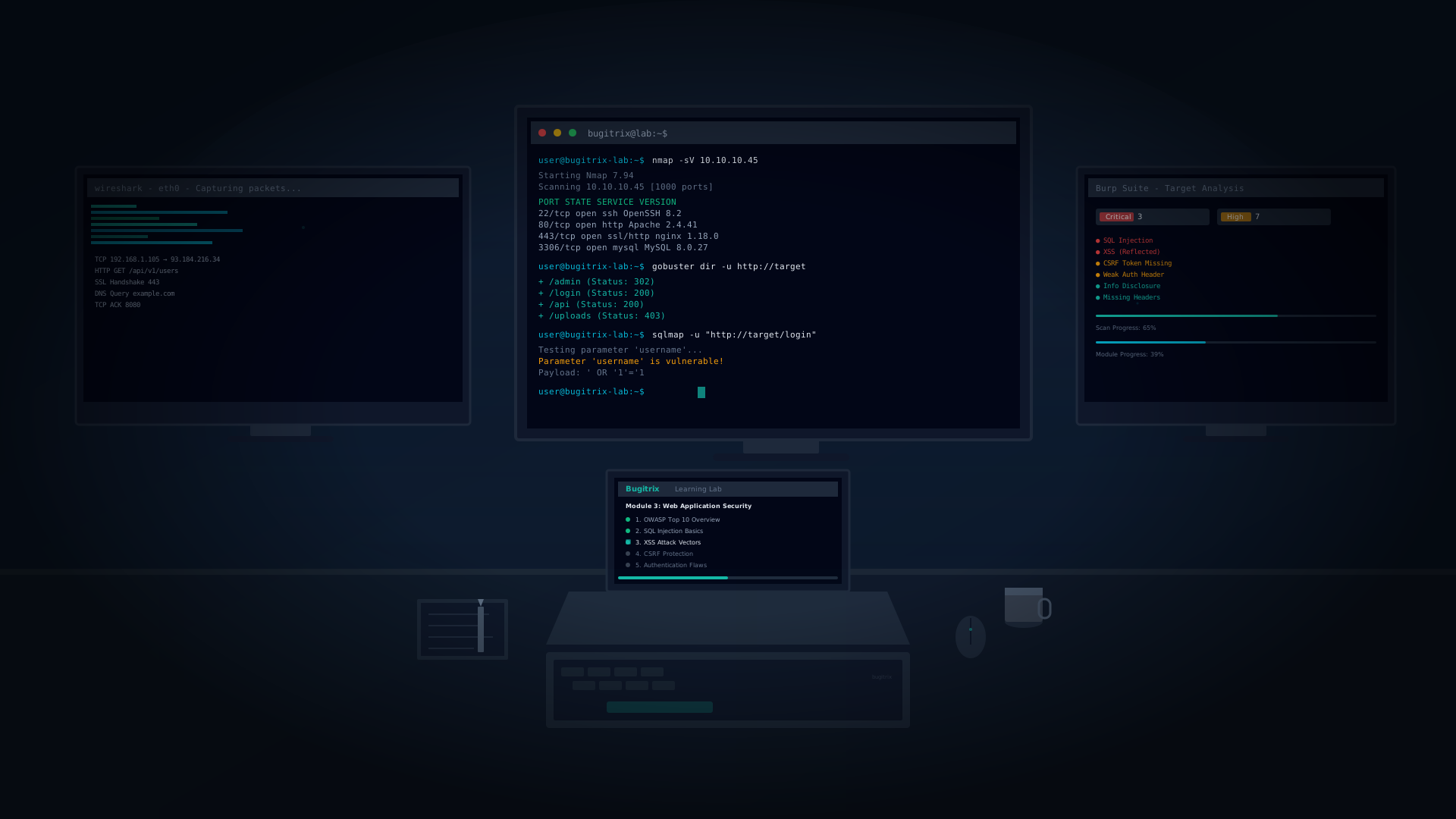
🔐 Introduction to Penetration Testing
👋 What Is Penetration Testing?
Penetration Testing (Pentesting) is the practice of legally testing systems, networks, and applications to find security weaknesses before attackers do.
Think of it as hiring a hacker to protect you 🛡️
Pentesters simulate real-world attacks to discover:
Security vulnerabilities
Misconfigurations
Weak passwords or access controls
Logic and design flaws
🎯 Why Penetration Testing Matters
Cyber attacks are increasing every day 🌍
Penetration testing helps organizations:
🔍 Identify vulnerabilities early
🛑 Prevent data breaches
💰 Avoid financial & reputation loss
📜 Meet compliance and security standards
👉 Simply put: Pentesting turns unknown risks into known problems.
🧠 Ethical Hacking vs Malicious Hacking
Not all hackers are bad. The key difference is permission and intent.
| Type | Purpose | Legal? |
|---|---|---|
| 🟢 Ethical Hacker / Pentester | Find & report vulnerabilities | ✅ Yes |
| 🔴 Malicious Hacker | Steal data or cause damage | ❌ No |
Penetration testers always work with permission and clear rules.
🛠️ What Does a Penetration Tester Actually Do?
A penetration tester:
🕵️ Gathers information about a target
🔎 Scans for weaknesses
🧪 Safely exploits vulnerabilities
📝 Reports findings with fixes
All of this is done in a controlled and legal environment.
🚀 What You’ll Learn on This Page
This page is designed to take you from zero to advanced in one place.
You will learn:
🔰 Beginner concepts (how pentesting works)
⚙️ Technical skills (tools, attacks, techniques)
🧠 Advanced thinking (real-world attack scenarios)
📄 Professional practices (reporting & ethics)
❤️ No Experience? No Problem!
You don’t need to be a hacker or coding expert to start.
We’ll:
Explain things step by step
Use simple language first
Build skills gradually
Connect theory with real-world examples
👉 If you’re curious and willing to learn, you’re ready 😄
🧭 How Penetration Testing Works
🧠 The Pentester’s Mindset
Penetration testing is not about random hacking ❌
It’s about thinking like an attacker while acting responsibly ✅
A penetration tester asks questions like:
What can I see from the outside? 👀
What can I access without permission? 🔓
How far can this weakness be abused? 🧪
👉 The goal is maximum understanding, minimum damage.
🔄 The Penetration Testing Lifecycle
Pentesting follows a structured process to ensure safe and effective testing.
| Phase | What Happens | Why It Matters |
|---|---|---|
| 📝 Planning | Define scope, rules, and permissions | Keeps testing legal |
| 🕵️ Reconnaissance | Gather information about the target | Finds entry points |
| 🔎 Scanning & Enumeration | Identify open ports & services | Maps attack surface |
| 💥 Exploitation | Safely exploit vulnerabilities | Proves real risk |
| 🧗 Post-Exploitation | Escalate access & assess impact | Shows damage level |
| 📄 Reporting | Document findings & fixes | Improves security |
⚖️ Why Methodology Is Important
Without a methodology:
Testing becomes chaotic
Results are unreliable
Legal risks increase
With a proper methodology:
✔️ Tests are repeatable
✔️ Findings are meaningful
✔️ Reports are trusted
👉 Professional pentesters always follow a process.
🛡️ Rules of Engagement (Very Important!)
Before any testing starts, pentesters must follow clear rules.
These rules define:
🎯 What systems can be tested
⏱️ When testing is allowed
🚫 What is off-limits
🧾 How data must be handled
No permission = No testing. Period.
🚀 Beginner Tip
If you’re just starting:
Don’t rush tools 🛑
Learn the process first
Understand why each step exists
👉 Tools change, but methodology stays.
🌐 Core Networking & Web Fundamentals for Pentesters
🧱 Why Fundamentals Matter (Bugitrix Insight)
At Bugitrix, we believe great pentesters are built on strong fundamentals, not just tools 🛠️
If you don’t understand how data moves, how servers respond, or how websites work, exploiting vulnerabilities becomes guesswork ❌ instead of skill ✅.
👉 Master the basics once. Use them forever.
🌐 Networking Basics Every Pentester Must Know
Before attacking anything, you must understand how systems communicate.
Key networking concepts:
🖥️ IP Address – Identifies a device on a network
🚪 Ports – Entry points to services (HTTP, SSH, FTP, etc.)
🔄 Protocols – Rules of communication (TCP, UDP)
🧭 DNS – Converts domain names to IP addresses
| Concept | Why It Matters in Pentesting |
|---|---|
| IP & Subnets | Identify targets & scope |
| Ports | Discover running services |
| Protocols | Choose correct attack methods |
| DNS | Find hidden systems & assets |
🌍 How the Web Works (Pentester View)
Every web application is a conversation between client and server 💬
| Component | Description |
|---|---|
| 🌐 Browser (Client) | Sends requests |
| 🖥️ Web Server | Processes requests |
| 🧠 Backend Logic | Handles authentication & data |
| 🗄️ Database | Stores sensitive information |
👉 Pentesters look for breaks in this conversation.
🔑 HTTP Basics You Must Understand
Web attacks rely heavily on HTTP.
Important parts:
📩 Requests (GET, POST, PUT, DELETE)
📤 Responses (Status codes)
🍪 Cookies (Sessions & authentication)
🧾 Headers (Metadata & controls)
| Status Code | Meaning | Pentester Use |
|---|---|---|
| 200 | OK | Normal response |
| 301 / 302 | Redirect | Auth flow testing |
| 401 / 403 | Unauthorized | Access control |
| 500 | Server Error | Possible vulnerabilities |
🐞 Bugitrix Learning Rule #1
“Never attack what you don’t understand.”
At Bugitrix, we teach you to:
✅ Read requests before modifying them
✅ Understand responses before exploiting them
✅ Learn why an attack works, not just how
🚀 From Beginner to Advanced
🔰 Beginners learn how networks & websites function
⚙️ Intermediate learners spot weak points
🧠 Advanced pentesters abuse logic, not just bugs
This foundation prepares you for:
SQL Injection 🧨
XSS 💉
Authentication bypass 🔓
API abuse ⚙️
❤️ Bugitrix Tip for Students
If networking feels confusing at first — that’s normal 😊
Every expert pentester started exactly where you are now.
👉 Slow learning + strong basics = unstoppable skills
💻 Linux, Windows & Command-Line Basics for Pentesters
🧠 Why Operating Systems Matter in Penetration Testing
Every attack, defense, exploit, and tool runs on an operating system.
If you don’t understand the OS, you’re only copy-pasting commands ❌.
At Bugitrix, we focus on OS mastery, not memorization.
👉 The better you know the system, the more powerful your attacks become.
🐧 Linux: The Pentester’s Home
Most penetration testing tools are built for Linux, especially distributions like Kali Linux.
Linux is used because it:
🛠️ Comes with built-in security tools
⚡ Is lightweight and customizable
🔓 Gives full control over the system
🧪 Allows deep testing and automation
| Linux Skill | Why It’s Important |
|---|---|
| File system navigation | Find configs, scripts, logs |
| Permissions | Exploit weak access controls |
| Processes | Identify running services |
| Networking commands | Inspect live connections |
🪟 Windows: The Most Common Target
While Linux is used for attacking, Windows is often the target 🎯.
Pentesters must understand:
👤 User vs Administrator roles
🔐 Access Control & permissions
🗂️ Registry & system services
🧠 Active Directory basics
| Windows Concept | Pentesting Use |
|---|---|
| User accounts | Privilege escalation |
| Services | Persistence & abuse |
| Event logs | Covering tracks |
| Active Directory | Enterprise attacks |
👉 Many real-world pentests fail without Windows knowledge.
⌨️ Command Line: Your Most Powerful Weapon
Graphical tools are helpful—but the command line is where real control lives.
Why pentesters love the CLI:
⚡ Faster than GUIs
🔁 Easy automation
🎯 Precise control
🔍 Better visibility
At Bugitrix, we treat the command line as a core skill, not an optional one.
🔰 Essential Linux Commands (Beginner Friendly)
You don’t need to memorize everything—understand the purpose.
| Command | Purpose |
|---|---|
| ls | List files |
| cd | Change directory |
| pwd | Show current path |
| cat | Read files |
| chmod | Change permissions |
| ps | View running processes |
| netstat / ss | Network connections |
⚙️ Windows Command Line & PowerShell Basics
Modern pentesting relies heavily on PowerShell.
Key areas:
📜 Viewing system info
🔍 Enumerating users & permissions
🌐 Inspecting network config
🧪 Running scripts in memory
| Tool | Why It Matters |
|---|---|
| CMD | Basic system interaction |
| PowerShell | Advanced enumeration |
| WMI | System & service queries |
🧗 From Basics to Privilege Escalation
OS knowledge directly enables:
🔓 Privilege escalation
🧬 Persistence techniques
📁 Sensitive file discovery
🔄 Lateral movement
This is where beginner knowledge turns into advanced impact.
🐞 Bugitrix Learning Rule #2
“If you can’t explain the command, you’re not ready to use it.”
We encourage:
Reading manual pages 📖
Understanding flags & output
Testing in safe labs 🧪
❤️ Beginner Reassurance
The command line can feel scary at first 😅
But every command you learn removes fear and builds confidence.
👉 Consistency beats speed. Always.
🚀 What This Prepares You For
After mastering this section, you’ll be ready for:
🔍 Information Gathering & Reconnaissance
🔎 Scanning & Enumeration
💥 Exploitation & Post-Exploitation
All with confidence, clarity, and control—the Bugitrix way 🐞
🔍 Information Gathering & Reconnaissance
🧠 Why Information Gathering Comes First
In penetration testing, you never attack blindly ❌.
You first learn everything possible about the target.
At Bugitrix, we teach:
“The more you know before attacking, the fewer mistakes you make.”
Information gathering (also called Reconnaissance) helps you:
🎯 Identify real targets
🔓 Discover potential entry points
🛑 Avoid unnecessary noise & detection
🧠 Plan smarter attacks
👀 Two Types of Reconnaissance
Recon is divided into Passive and Active techniques.
| Type | Description | Risk Level |
|---|---|---|
| 🟢 Passive Recon | Collecting info without touching the target | Low |
| 🔴 Active Recon | Direct interaction with the target | Higher |
👉 Professional pentesters always start passive.
🟢 Passive Reconnaissance (Beginner Friendly)
Passive recon uses publicly available information.
Common sources:
🌐 Search engines
🧾 WHOIS records
🗺️ DNS data
💼 Company websites
🐙 GitHub & public code
👥 Social media
| What You Find | Why It Matters |
|---|---|
| Domains & subdomains | Expands attack surface |
| Email formats | Phishing & auth attacks |
| Tech stack clues | Tool selection |
| Leaked credentials | High-impact risks |
🔴 Active Reconnaissance (Use Carefully)
Active recon involves directly querying the target systems.
Examples:
🔍 Ping & traceroute
🧪 DNS queries
📡 Port probing
🗂️ Directory discovery
| Technique | What It Reveals |
|---|---|
| DNS enumeration | Hidden assets |
| Service discovery | Running software |
| Directory listing | Exposed paths |
⚠️ Always follow scope and permission rules.
🧠 Thinking Like an Attacker (Bugitrix Mindset)
Good recon isn’t about tools—it’s about patterns.
Ask yourself:
🏢 Is this dev, test, or production?
🌐 Are there forgotten subdomains?
🔓 What was exposed by mistake?
🧩 How do systems connect together?
👉 Every small detail can unlock a big weakness.
🛠️ Common Recon Tools (Concept First)
Tools help—but understanding comes first.
| Category | Purpose |
|---|---|
| OSINT tools | Public data collection |
| DNS tools | Domain mapping |
| Network tools | Host discovery |
| Web tools | Asset identification |
At Bugitrix, tools are introduced after concepts, not before.
🐞 Bugitrix Learning Rule #3
“Recon is not scanning. Recon is intelligence.”
We train you to:
Document findings 📝
Correlate data 🧠
Reduce noise 🔇
Increase accuracy 🎯
❤️ Beginner Tip
If recon feels slow, that’s a good sign 😊
Rushing recon leads to:
Missed assets
Broken exploits
False assumptions
👉 Slow recon = clean exploitation
🚀 What Comes Next
With solid reconnaissance, you’re ready for:
🔎 Scanning & Enumeration
📊 Attack surface mapping
🎯 Target prioritization
This is where information turns into action—the Bugitrix way 🐞🔥
🔎 Scanning & Enumeration: Finding the Attack Surface
🧠 What Are Scanning & Enumeration?
After reconnaissance, the next step is to interact with the target in a controlled way.
🔍 Scanning answers: What is there?
🧠 Enumeration answers: How does it work?
At Bugitrix, we treat this phase as building a detailed map of the target system.
👉 No map = blind attacks.
🔍 Scanning: Discovering Live Systems & Services
Scanning focuses on identifying:
🖥️ Live hosts
🚪 Open ports
⚙️ Running services
🧾 Software versions
| Scan Type | What It Reveals |
|---|---|
| Host discovery | Active systems |
| Port scanning | Entry points |
| Service detection | What’s running |
| Version scanning | Known weaknesses |
Scanning turns unknown systems into known targets.
🧠 Enumeration: Turning Data into Intelligence
Enumeration goes deeper than scanning.
It helps identify:
👤 Users & accounts
🔐 Authentication mechanisms
📁 Shared resources
⚠️ Misconfigurations
| Enumeration Target | Why It Matters |
|---|---|
| Usernames | Brute-force & phishing |
| Services | Default credentials |
| File shares | Sensitive data |
| Configs | Privilege escalation |
👉 Enumeration is where real attack paths appear.
🧪 Common Areas to Enumerate
Professional pentesters enumerate everything that responds.
Key focus areas:
🌐 Web servers
📡 Network services
🧠 Databases
🪟 Windows services
🐧 Linux daemons
Every open service is a question waiting to be answered.
🛠️ Tools Are Helpers, Not Hackers (Bugitrix Rule)
Tools don’t find vulnerabilities—you do.
| Tool Category | Purpose |
|---|---|
| Network scanners | Identify ports & hosts |
| Service enumerators | Extract service info |
| Web enumerators | Find directories & APIs |
| Auth testers | Validate access controls |
At Bugitrix, we teach reading outputs, not just running commands.
⚖️ Accuracy Over Noise
Bad scanning creates:
❌ False positives
❌ Missed vulnerabilities
❌ Detection alerts
Good scanning focuses on:
✅ Correct timing
✅ Proper scope
✅ Clean results
👉 Slow, accurate scans beat fast, noisy ones.
🐞 Bugitrix Learning Rule #4
“If you can’t explain why a port is open, you haven’t finished enumeration.”
We train students to:
Document findings 📝
Link services to risks 🔗
Prepare exploitation paths 🎯
❤️ Beginner Reassurance
Scanning can feel overwhelming at first 😵
That’s normal.
Focus on:
One service at a time
Understanding responses
Asking why
👉 Confidence comes from clarity, not speed.
🚀 What This Leads To
After proper scanning & enumeration, you’re ready for:
💥 Exploitation
🔓 Authentication bypass
🧗 Privilege escalation
This is where information becomes access—the Bugitrix way 🐞🔥
💥 Exploitation Basics: Turning Vulnerabilities into Access
🧠 What Is Exploitation?
Exploitation is the process of safely using a vulnerability to prove that it can be abused.
At Bugitrix, we define exploitation as:
“Demonstrating real risk with minimal impact.”
You are not trying to:
❌ Destroy systems
❌ Steal unnecessary data
❌ Show off
You are trying to:
✅ Prove a weakness exists
✅ Show what an attacker could do
✅ Help organizations fix the issue
🔓 When Is a Vulnerability Exploitable?
Not every vulnerability leads to exploitation.
A vulnerability becomes exploitable when:
⚠️ It can be reached from your position
🔑 Required conditions are met
🧩 No strong controls block it
| Factor | Example |
|---|---|
| Accessibility | Public-facing service |
| Privileges | Low-auth user |
| Complexity | Simple input flaw |
| Impact | Data access or control |
👉 Context matters more than the bug itself.
🧪 Common Exploitation Categories
Pentesters encounter certain vulnerability types repeatedly.
| Category | What It Means |
|---|---|
| 🔐 Authentication flaws | Login bypass, weak passwords |
| 💉 Injection flaws | SQL, command, LDAP injection |
| 🧬 Memory issues | Buffer overflows |
| ⚙️ Misconfigurations | Default creds, open services |
| 🧾 Logic flaws | Broken workflows |
Understanding categories helps you recognize patterns faster.
🛠️ Manual vs Automated Exploitation
Automation helps—but manual exploitation wins 🧠.
| Approach | Strength |
|---|---|
| Automated | Speed & coverage |
| Manual | Precision & creativity |
At Bugitrix, we teach:
🧠 Manual testing first
🤖 Automation for support
🔍 Verification always
🎯 Controlled Exploitation (Professional Rule)
Exploitation must be:
🎯 Targeted
🛑 Limited in scope
📸 Well-documented
Examples of safe proof:
Reading a test file
Accessing a low-privilege account
Showing controlled command execution
👉 Proof ≠ Damage
🐞 Bugitrix Learning Rule #5
“If you can’t explain the impact, the exploit is incomplete.”
We train students to:
Tie exploits to real-world risks 🌍
Avoid unnecessary payloads 🧨
Think like defenders too 🛡️
❤️ Beginner Reality Check
Exploitation can fail many times—and that’s okay 😊
Failures teach you:
Why conditions matter
How defenses work
Where assumptions break
👉 Every failed exploit sharpens your skills.
🚀 What Comes After Exploitation
Once access is gained, the next questions are:
🔓 How much access do I really have?
🧗 Can privileges be increased?
📊 What’s the real impact?
That leads us to:
👉 Post-Exploitation & Privilege Escalation—the advanced phase of pentesting.
🧗 Post-Exploitation & Privilege Escalation
🧠 What Is Post-Exploitation?
Post-exploitation begins after you gain initial access to a system.
At this stage, the question is no longer:
“Can I get in?”
But instead:
“What can I do from here?”
At Bugitrix, we treat post-exploitation as impact assessment, not chaos.
🔍 Goals of Post-Exploitation
Professional pentesters focus on controlled objectives.
Key goals include:
📊 Measuring real-world impact
🔓 Identifying privilege boundaries
🧠 Understanding system trust relationships
📝 Collecting evidence for reporting
👉 The goal is insight, not persistence for fun.
🧗 What Is Privilege Escalation?
Privilege escalation is the process of gaining higher permissions than initially allowed.
| Level | Example |
|---|---|
| Low privilege | Standard user |
| Medium privilege | Service account |
| High privilege | Admin / Root |
An attacker always tries to move up, and pentesters must show if it’s possible.
🧠 Common Privilege Escalation Paths
Privilege escalation often happens due to misconfigurations, not complex exploits.
| Category | Example |
|---|---|
| 🔓 Weak permissions | Writable system files |
| ⚙️ Misconfigured services | Running as admin/root |
| 🧾 Exposed credentials | Plain-text passwords |
| 🧪 Vulnerable software | Known local exploits |
👉 Most escalations are mistakes, not magic.
🌐 Lateral Movement (Advanced Concept)
In real environments, systems are connected.
Lateral movement means:
➡️ Moving from one system to another
🔁 Reusing credentials or trust relationships
🧠 Mapping internal networks
This is especially common in:
🏢 Corporate networks
🪟 Active Directory environments
🛡️ Staying Ethical During Post-Exploitation
This phase carries higher risk, so discipline matters.
At Bugitrix, we enforce:
🛑 Minimal access needed
📸 Clear evidence only
🚫 No unnecessary data extraction
🧾 Respect scope at all times
👉 More access ≠ better testing.
🐞 Bugitrix Learning Rule #6
“Privilege escalation proves severity, not skill level.”
We train students to:
Stop once impact is proven
Explain why escalation was possible
Recommend clear fixes 🛠️
❤️ Beginner Mindset Shift
Post-exploitation can feel intimidating 😬
That’s normal—this is advanced territory.
Remember:
You are not expected to know everything
Enumeration still matters here
Small findings lead to big access
👉 Stay curious, stay calm, stay ethical.
🚀 What This Prepares You For
This phase leads directly into:
📄 Professional reporting
⚖️ Risk classification
🛠️ Security improvement recommendations
Which brings us to the final step:
👉 Reporting, Ethics & Becoming a Professional Pentester
📄 Reporting, Ethics & Becoming a Professional Pentester
🧠 Why Reporting Is the Most Important Skill
Finding vulnerabilities is only half the job.
At Bugitrix, we teach:
“If it’s not reported clearly, it doesn’t exist.”
A penetration test is considered successful only when:
Issues are clearly documented
Risks are understandable to non-technical teams
Fixes are actionable
👉 Good reporting creates real security improvements.
📝 What Makes a Great Pentest Report?
A professional report tells a clear story, not just technical data.
| Report Section | Purpose |
|---|---|
| 🎯 Scope | What was tested |
| 🔍 Findings | What was discovered |
| 💥 Impact | What could happen |
| 📸 Evidence | Proof of exploitation |
| 🛠️ Fixes | How to remediate |
At Bugitrix, we emphasize clarity over complexity.
⚖️ Ethics: The Line You Never Cross
Penetration testing is built on trust.
Ethical pentesters must:
✅ Test only what is allowed
🔐 Protect sensitive data
🧾 Respect legal boundaries
🛑 Stop once impact is proven
| Ethical Rule | Why It Matters |
|---|---|
| Permission first | Legal safety |
| Least impact | Client trust |
| Honest reporting | Professional integrity |
👉 Skills without ethics are dangerous.
🧭 Laws, Permission & Responsibility
Always remember:
❌ Testing without permission is illegal
📜 Rules of engagement protect both sides
⚠️ Even curiosity can become a crime
At Bugitrix, we never promote illegal hacking—only ethical, legal learning.
🚀 Becoming a Professional Penetration Tester
Penetration testing is a long-term skill, not a shortcut.
Key paths include:
🏢 Pentest consultant
🐞 Bug bounty hunter
🔐 Security analyst
🧠 Red team member
| Skill Area | Importance |
|---|---|
| Fundamentals | 🔥 Critical |
| Practice & labs | 🔥 Critical |
| Reporting | 🔥 Critical |
| Communication | ⭐ High |
| Certifications | ⭐ Helpful |
📚 Learning the Bugitrix Way
At Bugitrix, we focus on:
🧠 Deep understanding
🧪 Safe hands-on practice
📈 Progressive learning paths
🐞 Real-world security thinking
We don’t teach you to “hack fast.”
We teach you to hack right.
❤️ Final Words for Students
If you reached this section—respect 🙌
You now understand how penetration testing works from beginner to advanced.
Remember:
Everyone starts confused
Experts were once beginners
Consistency beats talent
👉 Stay ethical. Stay curious. Stay Bugitrix.