
Imagine flying to a secret location, sitting in a room full of the world's best hackers, and walking out with a check worth tens of thousands of dollars — all for legally breaking into Microsoft's systems.
That's not a fantasy. That's Zero Day Quest — and in a single event, Microsoft paid out $1.6 million in bounties.
The real question is: how do you get into a room like that?
This blog breaks down exactly how Zero Day Quest worked, what kind of hackers got invited, what vulnerabilities paid the most, and the specific skill roadmap you need to start building right now if you want a seat at elite live hacking events in 2026 and beyond.
Let's get into it.
What Is Zero Day Quest? (And Why It's a Big Deal)
Zero Day Quest is Microsoft's flagship live hacking event (LHE) — an invite-only, high-stakes competition where elite security researchers get direct access to Microsoft's engineering teams and real production systems.
It's not a CTF. It's not a practice lab. It's the real thing.
Microsoft launched it as part of their broader bug bounty expansion under the Microsoft Security Response Center (MSRC). The event targets the most critical attack surface areas — specifically AI systems, cloud infrastructure, and Azure services — because that's where the most dangerous vulnerabilities live today.
Here's what makes Zero Day Quest different from regular bug bounty programs:
| Feature | Regular Bug Bounty | Zero Day Quest (LHE) |
|---|---|---|
| Access | Public, open to all | Invite-only |
| Scope | Broad, general targets | Focused on AI + Cloud |
| Payout | Standard bounty rates | Up to 4x bonus multipliers |
| Support | Email-based MSRC contact | Direct access to engineers |
| Environment | Production only | Production + special lab access |
| Networking | None | Direct contact with Microsoft security team |
| Prestige | Moderate | Extremely high |
That bonus multiplier is the key detail most people miss. Zero Day Quest didn't just pay standard rates — it paid bonus multipliers on top of existing bounty amounts, which is why a single event crossed $1.6 million total.
The $1.6 Million Breakdown — Where Did the Money Go?
Let's talk about the real numbers, because this is what makes Zero Day Quest one of the highest-paying hacking events ever organized by a single company.
Microsoft confirmed the total payout of $1.6 million at Zero Day Quest, with the highest individual rewards going to researchers who found critical vulnerabilities in:
| Target Category | Max Bounty Per Bug | Bonus Multiplier Available |
|---|---|---|
| Microsoft AI / Copilot Systems | Up to $30,000 | Yes — up to 4x |
| Azure Core Infrastructure | Up to $60,000 | Yes — up to 4x |
| Azure AI Services | Up to $30,000 | Yes |
| Microsoft 365 / Identity | Up to $27,000 | Partial |
| Hyper-V / VM Escape | Up to $250,000 | Yes |
| Cloud-to-On-Prem Lateral Movement | Up to $60,000 | Yes |
A researcher who found a critical Azure vulnerability worth $30,000 in base bounty could walk away with $120,000 from a single bug with the multiplier applied.
That's why the event broke records. And that's why the competition to get invited is fierce.
What Skill Profile Did the Winners Have?
This is the part that most blog posts skip over, but it's the most valuable section for you.
The researchers who dominated Zero Day Quest weren't random hackers who got lucky. They had very specific, deeply developed skill sets. Based on disclosed reports, community interviews, and MSRC communications, here's the profile that consistently appeared among top performers:
1. Deep Cloud Security Knowledge (Especially Azure)
Winners understood how Azure Active Directory, managed identities, storage account access controls, and service principal authentication actually work — not just at the surface level, but at the architectural level.
They knew how misconfigurations in one Azure service could cascade into another. They understood cross-tenant trust boundaries. They could read Azure ARM templates and spot privilege escalation paths that automated scanners would never find.
2. AI/LLM Attack Familiarity
Zero Day Quest specifically targeted Microsoft Copilot and AI services — and the top researchers understood how to probe these systems. This means prompt injection, indirect prompt injection via documents and emails, tool call manipulation, and data exfiltration through LLM-assisted workflows.
This is a brand new attack surface that most security researchers haven't deeply explored yet — which means it's a massive opportunity for you right now.
3. Authentication and Identity Exploitation
A huge category of high-value Microsoft bugs involves OAuth flows, token theft, SSRF into metadata services, and identity federation attacks. Winners understood how Microsoft's identity stack works end-to-end — from Azure AD (now Entra ID) to conditional access policies to JWT manipulation.
4. Consistent Bug Bounty Track Record
Nobody gets invited to Zero Day Quest with a blank HackerOne profile. Every researcher who got an invitation had a history — valid findings on Microsoft's public bug bounty programs, a reputation in the security research community, and ideally some disclosed CVEs or public write-ups.
5. Professional Communication and Report Writing
This one sounds boring but it's critical. Microsoft's team has to understand what you found, why it matters, and how to reproduce it. Researchers who wrote clear, well-documented reports got taken more seriously — and got into invite-only programs faster.
How Live Hacking Events (LHEs) Work — The Full Picture

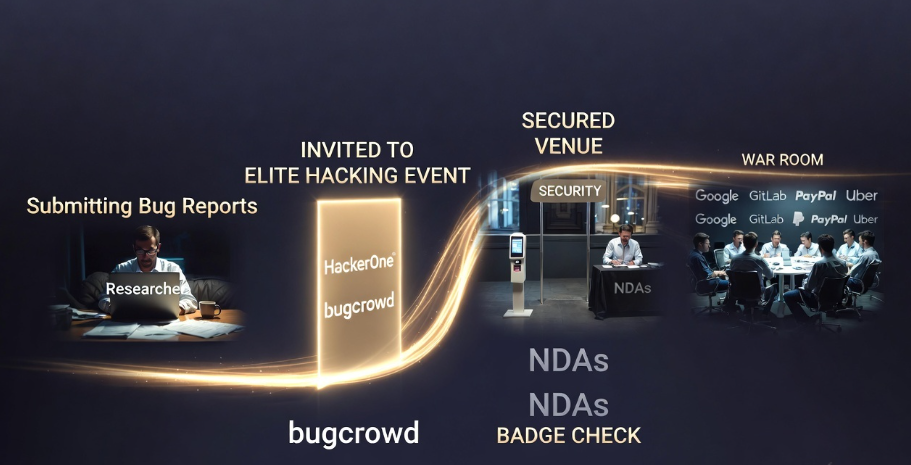
Zero Day Quest is one of many live hacking events organized across the industry. HackerOne and Bugcrowd both run regular LHEs for companies like Google, GitLab, PayPal, Uber, and others.
Here's how the invitation and participation process typically works:
Phase 1: Build Your Public Profile
Everything starts with your public bug bounty profile. You submit valid bugs on public programs. Your reputation score goes up. You build a history of critical and high findings — not just informational issues or duplicates.
HackerOne uses a Signal and Impact score to measure your effectiveness. Bugcrowd uses a Priority score. Both platforms track your finding accuracy, severity of bugs submitted, and how well your reports are written.
| Platform Metric | What It Measures | Why It Matters for LHE Invites |
|---|---|---|
| HackerOne Signal | Ratio of valid to invalid reports | High signal = trusted researcher |
| HackerOne Impact | Severity-weighted valid findings | Higher impact = LHE-ready |
| Bugcrowd Priority Score | Combined accuracy + severity + consistency | Directly used for invite decisions |
| MSRC Researcher Ranking | Total points across Microsoft programs | Primary metric for Zero Day Quest |
Phase 2: Get Noticed on Target Programs
Live hacking events are almost always organized around a specific company. If you want to get invited to a Microsoft LHE, you need to be actively and successfully hacking Microsoft programs on HackerOne — specifically the MSRC-managed scopes.
Same rule applies to other companies. Want to get into Google's LHE? Have findings on their VRP. Want Uber's private program? Show up on HackerOne with valid findings in their stack.
Phase 3: Receive or Apply for an Invitation
Some LHEs are purely invite-only — the program manager picks you based on your profile. Others have an application process where researchers submit their background, methodology, and notable findings.
HackerOne has an official guide on what makes a researcher invitation-worthy. Bugcrowd's elite researcher program (formerly called the "Elite" or "Bounty Hunter" tier) also feeds into private and live event access.
Phase 4: The Event Itself
LHEs typically run for 1 to 5 days. During that time, you get access to scoped targets, sometimes special testing environments, and direct Slack/Discord channels with the company's engineering team.
The format creates something unique — bugs that would take weeks to get triaged during normal programs get confirmed within hours because the engineers are right there. You get faster feedback, faster payouts, and a real relationship with the internal team.
How to Start Building Toward Live Hacking Events in 2026
Here's the honest truth: most people won't get invited to an LHE this year. But the people who start building the right skills and profile today are exactly the ones who'll be sitting in those rooms in 12 to 18 months.
Here's your practical roadmap:
Step 1: Pick a Tech Stack and Go Deep
Stop trying to hack everything. The researchers who win at LHEs are specialists. Pick one area — Azure, AWS, AI systems, mobile, web authentication — and go uncomfortably deep.
For Microsoft-specific events, the highest-value path right now is:
- Azure infrastructure and IAM
- Microsoft AI / Copilot attack surface
- Microsoft 365 and Exchange Online
Step 2: Learn to Read Documentation Like an Attacker
The best bug hunters find bugs in features that were recently added or recently changed. They read Microsoft's changelog, Azure's release notes, and Entra ID's documentation update history.
When Microsoft adds a new feature, there's a window where that feature hasn't been heavily tested. New features = new attack surface. Make reading official documentation a weekly habit.
Step 3: Submit to Microsoft's Public Programs First
Microsoft runs multiple public bug bounty programs on HackerOne. Start with the Microsoft Applications or Microsoft Identity bounty programs. Build a track record. Every valid finding counts toward your MSRC researcher ranking.
Don't skip this step. There's no shortcut. You need the track record before the invitation comes.
Step 4: Write Public Write-Ups
After bugs are patched and disclosed, write them up. Post them on your blog, on Medium, on LinkedIn. Not only does this build your personal brand — it signals to program managers that you're a serious researcher who contributes to the community.
Some researchers have gotten LHE invitations directly because a program manager read their write-up.
Step 5: Engage with the Community
The bug bounty and security research world is smaller than you think. People know each other. Program managers follow top researchers on Twitter/X. Being active in the community — sharing knowledge, collaborating on challenges, attending virtual or in-person security conferences — accelerates everything.
7 Skills You Need Before Applying to Live Hacking Events ✅
This is the checklist you've been building toward. Print it. Save it. Come back to it every 3 months and honestly rate yourself.
| # | Skill | Why It Matters | How to Build It |
|---|---|---|---|
| 1 | Cloud IAM & Architecture | Most LHE targets are cloud-native | Build in Azure free tier, study IAM policies, practice privilege escalation labs |
| 2 | Web App Pentesting (OWASP Top 10 +) | Baseline skill required everywhere | HackTheBox, PortSwigger Web Academy, real programs |
| 3 | Authentication & OAuth Attack Chains | Identity bugs = high severity = LHE invites | Study OAuth 2.0 spec, practice token interception, read disclosed reports |
| 4 | API Security Testing | Modern apps = API-first, high attack surface | Test REST/GraphQL APIs, learn to use Burp Suite on API targets |
| 5 | AI/LLM Security (Prompt Injection, etc.) | Fastest growing LHE category in 2025–26 | PortSwigger AI labs, Gandalf game, LLM bug bounty programs |
| 6 | Report Writing & PoC Development | Gets bugs accepted fast, builds reputation | Read top disclosed reports on HackerOne, practice writing for clarity |
| 7 | Recon & Attack Surface Mapping | Finding what others miss = unique bugs | Learn Subfinder, Amass, Shodan, OSINT techniques on in-scope assets |
Be honest with yourself. If you're a 3/10 on cloud IAM right now, that's okay — but now you know what to work on.
The AI Attack Surface: Why This is the Biggest Opportunity Right Now

Zero Day Quest's focus on Microsoft AI systems and Copilot wasn't a coincidence. It reflects a massive industry shift.
Every major company is racing to deploy AI features. Microsoft has baked Copilot into Teams, Outlook, Word, Azure, GitHub, and dozens of other products. Each integration is a new attack surface. And almost none of these systems have been thoroughly tested by the security research community.
Here's what makes AI security so valuable for bug bounty hunters right now:
Indirect Prompt Injection — An attacker plants a malicious prompt inside a document, email, or web page. When a Copilot-style AI reads that content on behalf of a user, the injected prompt hijacks the AI's behavior. This can lead to data exfiltration, unauthorized actions, or impersonation.
Tool Call Manipulation — Many AI systems have the ability to call external tools or APIs. If an attacker can manipulate what tools get called and with what parameters, they can potentially execute actions the user never intended.
Memory and Context Poisoning — AI assistants that retain memory across sessions can be poisoned with false information that persists and influences future interactions.
Data Exfiltration via AI Channels — Getting the AI to leak sensitive information from its context window or from connected data sources through cleverly crafted prompts.
Microsoft specifically offered bonus multipliers for AI vulnerability findings at Zero Day Quest. That's not going to stop. The AI attack surface is only growing — and researchers who build expertise here in 2026 will be the ones getting the biggest checks at 2027's events.
Real Numbers: What Can You Earn at Live Hacking Events?
Let's be transparent about the money because this is aspirational content — but it should also be realistic.
| Experience Level | Typical LHE Payout Range | What It Requires |
|---|---|---|
| First LHE (Junior) | $500 – $5,000 | Valid medium/high bugs, good recon |
| Intermediate Researcher | $5,000 – $25,000 | Multiple valid criticals, clean reports |
| Experienced LHE Veteran | $25,000 – $100,000+ | Unique attack chains, critical systems |
| Elite (e.g., Zero Day Quest top performer) | $100,000 – $250,000+ | Zero days in core infrastructure or AI |
The $1.6 million at Zero Day Quest was split among a group of researchers — not one person. But individual payouts in the $30,000 to $120,000 range were absolutely real, confirmed by community disclosures.
For context, the average Indian bug bounty hunter who participates in their first LHE typically earns between $2,000 and $15,000 in a single event — which, converted to INR, is a life-changing amount for someone early in their career.
And that's just the beginning. After your first LHE, invitations to subsequent events come much faster because your track record is proven.
Common Mistakes That Get You Rejected From Live Hacking Events

Knowing what to do is only half the picture. Here's what gets researchers rejected or ignored:
Submitting informational or duplicate bugs to build "volume" — Program managers can see your history. A feed full of duplicate and informational findings tells them you don't have the depth they need at an LHE. Quality always beats quantity.
Ignoring the specific tech stack of the target company — If you've never touched Azure and you're applying for a Microsoft LHE, that's an immediate mismatch. Focus your energy on programs that align with your expertise.
Poor report quality — Vague reproduction steps, missing screenshots, unclear impact statements. If a triage team has to email you three times to understand what you found, that damages your reputation.
Zero public presence — Program managers look you up. If there's nothing to find — no write-ups, no conference talks, no community presence — it raises questions about your depth and commitment to the craft.
Burning bridges — The security research community is tight-knit. Publicly complaining about triage decisions, being aggressive with program staff, or acting entitled gets you a quiet reputation that follows you.
How Bugitrix Can Help You Build This Path
You don't have to figure this out alone.
At Bugitrix, we've built a community and resource hub specifically for security researchers who are serious about going from beginner to elite. Whether you're just starting out or you're already finding bugs and want to break into private programs and live hacking events, there's a path here for you.
🔥 Ready to Level Up? Here's Where to Start:
📚 Read More on Bugitrix Explore our full library of bug bounty guides, career content, and technical deep-dives at bugitrix.com. New content drops regularly covering real attack techniques, disclosed bug write-ups, and industry news.
📲 Join Our Telegram Channel Get daily cybersecurity tips, bug bounty news, and tool updates delivered straight to your phone. 👉 t.me/bugitrix
No noise. No spam. Just genuinely useful content every day.
🤝 Join the Bugitrix Community Forum Connect with other hunters, ask questions, share findings, and collaborate with researchers who are on the same journey. 👉 bugitrix.com/forum/help-1
The community is one of the fastest ways to grow — because the people who are one step ahead of you are already there, and they're willing to help.
🎓 Apply for Mentorship If you're serious about getting into private programs and live hacking events, mentorship is the fastest route. Our mentorship program connects you with experienced researchers who've already walked this road. 👉 bugitrix.com/mentorship-details
Spots are limited. Apply early.
📄 Build a Resume That Gets You Noticed Your security resume needs to look different from everyone else's. We help you build a resume that highlights your bug bounty work, CVEs, tools, and methodology in a way that program managers and security hiring teams actually respond to. 👉 Build Your Resume With Us
Final Thoughts: The Room Is Real. The Money Is Real. The Question Is Whether You'll Be Ready.

Microsoft didn't hand out $1.6 million as a PR stunt. They did it because finding these bugs through a structured event is cheaper and more effective than getting breached. The researchers who walked out of Zero Day Quest with five and six-figure payouts weren't lucky — they were prepared.
The Azure vulnerabilities, the AI attack surfaces, the identity chain exploits — these bugs exist in every major cloud platform right now. They're sitting there, waiting to be found, by researchers who have taken the time to develop the right skills and build the right reputation.
You're reading this blog because some part of you already knows this is possible. Now you have the roadmap.
Start with one skill from the checklist. Commit to one Microsoft public program. Write your first detailed bug report. Join the Bugitrix community and find the people who are already a few steps ahead.
The next Zero Day Quest — or the next HackerOne LHE, or the next Bugcrowd elite event — has seats with names on them. One of those seats could have your name.
Go build toward it.