

Apple pays ethical hackers up to $5,000,000 for a single vulnerability report. Not a year's salary. Not a career total. One. Bug.
That number sounds like clickbait. It isn't. Apple's Security Research Device Program is one of the most sophisticated, highest-paying, and least-understood bug bounty programs on the planet. While most hackers are grinding $500 bounties on HackerOne, a small group of elite researchers are quietly cashing cheques that rival Silicon Valley executive salaries.
This blog breaks down exactly how Apple's bug bounty works, what vulnerabilities qualify for the big payouts, what the journey from discovery to payout actually looks like, and — most importantly — how you can start building the skills to compete in this arena.
Let's get into it.
🎯 Want this entire guide as a PDF?
We've packed everything into a free downloadable cheat sheet — payout table, checklists, skill roadmap, and all resources in one place.
⬇ Download the Free Apple Bug Bounty PDF Guide
Bugitrix_Apple_BugBounty_Guide.pdf
Save it. Print it. Use it as your roadmap.
What Is Apple's Bug Bounty Program?
Apple launched its Apple Security Research program in 2016, initially limited to invited researchers only. After significant pressure from the security community, Apple opened it to all researchers in 2019.
Today, the program covers:
- iOS and iPadOS
- macOS
- watchOS and tvOS
- iCloud
- Apple Silicon firmware
- Private Cloud Compute (PCC) — the newest and highest-paying category
The program is officially managed through security-research.apple.com, where researchers submit vulnerabilities and Apple's internal security team reviews them.
But the real game-changer came when Apple introduced the Security Research Device Program — a special initiative that gives elite researchers access to a modified iPhone with deep debugging capabilities. This changed everything.
The Security Research Device (SRD) — Apple's Secret Weapon

Most bug bounty programs give you a web app, a staging environment, or maybe some API credentials to test against. Apple does something completely different.
The Apple Security Research Device (SRD) is a special iPhone specifically built for security research. It's not a consumer device. It's a hardware-modified version of the iPhone that lets researchers:
- SSH into the device directly
- Run custom entitlements and bypass certain security restrictions
- Use debugging tools that are normally unavailable on production iPhones
- Access lower-level system components that aren't exposed on regular devices
This is significant. Normally, iOS is one of the most locked-down operating systems in the world. Jailbreaking is notoriously difficult, and most security researchers have extremely limited visibility into the OS internals. The SRD lifts many of these barriers for approved researchers.
How do you get one?
You apply. Apple reviews your research history, your public CVEs, your prior responsible disclosures, and your overall credibility as a security researcher. If approved, you receive an SRD on a 12-month loan basis. You keep it for a year, conduct research, and return it.
This program creates a two-tier ecosystem:
- General researchers who submit bugs using standard consumer devices
- SRD researchers who have deep access and can find higher-severity, harder-to-reach vulnerabilities
If you want the $5 million, the SRD track is where you want to be.
The Full Payout Structure — Where The Real Money Is
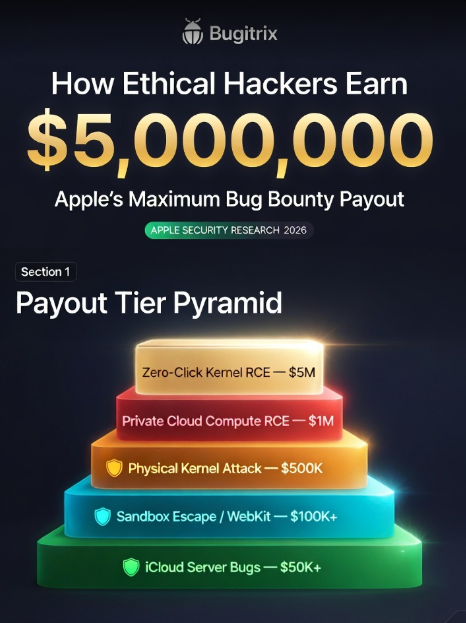
Here is Apple's official bounty payout table as of 2026, broken down by vulnerability category and impact:
| Vulnerability Category | Maximum Payout |
|---|---|
| Zero-click kernel code execution with persistence | $5,000,000 |
| Zero-click remote code execution on Private Cloud Compute | $1,000,000 |
| Network attack without user interaction — full kernel compromise | $1,000,000 |
| iCloud account access — unauthorized data extraction | $500,000 |
| Physical attack — kernel code execution (locked device) | $500,000 |
| User-installed app — kernel code execution | $150,000 |
| App sandbox escape | $100,000 |
| Cross-app data access without user interaction | $100,000 |
| WebKit / browser exploitation | $100,000 |
| Device unlock without passcode | $250,000 |
| Access to sensitive data without unlocking | $100,000 |
| iCloud data exfiltration via server-side vulnerability | $50,000–$500,000 |
📌 Bonus: Apple offers a 25% payout bonus for vulnerabilities found exclusively on Security Research Devices, and additional bonuses for finding bugs in beta software before public release.
📄 Don't lose this payout table. Download the full Bugitrix PDF guide — it includes the complete Apple payout breakdown, severity tiers, bonus structures, and a printable submission checklist you can use for every report you write. ⬇ Get the Free PDF
Bugitrix_Apple_BugBounty_Guide.pdf
Used by 1,000+ bug bounty hunters in the Bugitrix community.
The $5 million figure is not theoretical. It sits at the top of Apple's official published payout table for the single most dangerous class of vulnerability: a zero-click, remote kernel code execution with persistence that requires no user interaction whatsoever.
What Exactly Is a Zero-Click Vulnerability?
This term gets thrown around a lot, so let's define it clearly.
A zero-click vulnerability is a security flaw that can be exploited without any action from the victim. No link to click. No file to open. No phishing required. The attacker simply sends a specially crafted packet, message, or request — and the device is compromised.
The most famous real-world example is FORCEDENTRY, the zero-click iMessage exploit used by NSO Group's Pegasus spyware. This vulnerability allowed full compromise of an iPhone simply by sending an iMessage — the victim didn't have to do anything.
That class of vulnerability is what sits at the top of Apple's payout table. Finding one legitimately, reporting it responsibly, and keeping it to yourself rather than selling it to a government agency? That's the $5 million path.
For comparison, a zero-click iOS exploit on the gray market (sold to intelligence agencies or exploit brokers) can fetch $10–35 million. Apple's bounty is lower than the black market price — but it comes without legal risk, prison time, or the moral weight of enabling state surveillance.
Private Cloud Compute — The Newest $1 Million Category
Apple introduced Private Cloud Compute (PCC) as the AI processing backbone for Apple Intelligence, their on-device and cloud AI system. PCC is Apple's attempt to do AI computation in the cloud while maintaining user privacy.
Apple made a bold claim: they built PCC to be auditable and verifiable, even for external security researchers. They published the PCC source code, virtual research environments, and technical documentation specifically to invite scrutiny.
This created an entirely new bug category with payouts up to $1,000,000 for remote code execution on PCC infrastructure.
The PCC attack surface includes:
- Accidental data disclosure — PCC exposing user data due to a bug: up to $250,000
- External access to user request data — Bypassing PCC's privacy guarantees: up to $500,000
- Arbitrary code execution on PCC nodes — Full compromise of cloud compute infrastructure: up to $1,000,000
If you have cloud security skills, container security experience, or an interest in confidential computing — PCC is one of the most exciting (and lucrative) research areas in the industry right now.
What Does a High-Value Submission Actually Look Like?
Let's walk through the lifecycle of a serious Apple bug bounty submission — not a $500 XSS on a web panel, but the kind of research that earns six to seven figures.
Step 1 — Identify the Attack Surface
High-value Apple research starts with studying the components that have the most impact if compromised. This means kernel subsystems, inter-process communication (IPC) mechanisms, image parsing libraries, audio/video decoders, and network stacks.
The ImageIO framework — which handles image parsing in iOS — has been a historically rich target. So has WebKit, iMessage, CoreText, and Bluetooth handling code. Researchers spend weeks or months just mapping these attack surfaces before writing a single line of exploit code.
Step 2 — Fuzzing and Vulnerability Discovery
Most high-value iOS vulnerabilities are found through fuzzing — a technique where you feed massive amounts of malformed, random, or mutated input into a target and watch for crashes.
Elite researchers write custom fuzzers for Apple's frameworks. They use tools like:
- libFuzzer and AFL++ for coverage-guided fuzzing
- Frida for dynamic instrumentation and hooking
- LLDB for debugging on SRD devices
- IDA Pro or Ghidra for reverse engineering Apple's closed-source binaries
This phase can take months. Serious iOS researchers treat this like a full-time job — because it is.
Step 3 — Exploit Development
Finding a crash is just the beginning. A crash proves something is broken, but it doesn't prove it's exploitable. The next step is developing a proof-of-concept exploit that demonstrates real-world impact.
This requires deep knowledge of:
- Memory corruption techniques (heap spraying, use-after-free, type confusion)
- Apple's exploit mitigations (PAC — Pointer Authentication Codes, ASLR, sandboxing)
- Kernel exploitation techniques specific to Apple Silicon
This is where most researchers stop. Building a reliable, weaponized exploit for a modern iPhone is genuinely one of the hardest technical challenges in offensive security.
Step 4 — Writing the Report
The quality of your report directly affects your payout. Apple's team needs to:
- Understand the vulnerability clearly
- Reproduce it from your instructions
- Assess its true severity and impact
- Trust that the disclosure is complete and honest
A good submission includes:
- A clear technical explanation of the root cause
- Step-by-step reproduction instructions
- A working proof-of-concept
- A realistic assessment of real-world exploitability
- Suggested mitigations
Researchers who write sloppy reports sometimes get underpaid relative to what their bug deserves. Writing matters.
Step 5 — The Review and Negotiation Process
After submission, Apple's security team reviews the bug. This process can take weeks to months. Apple triages severity, confirms reproduction, and assigns a payout.
You can push back. If you believe your bug is rated too low, you can make the case for a higher payout with additional evidence of exploitability. This negotiation phase is real, and researchers who know their bug's true value advocate for themselves.
Step 6 — Patch, CVE, and Payment
Once Apple patches the bug, they typically credit the researcher in their security advisory. A CVE (Common Vulnerabilities and Exposures) number is assigned. Payment follows.
The entire process from submission to payment can take 3 to 9 months for complex vulnerabilities. Patience is part of the job.
Who Are the Researchers Actually Earning These Payouts?

Let's put some real names and context to this.
Samuel Groß (saelo) — A researcher at Google Project Zero who published groundbreaking work on JavaScript engine exploitation, including WebKit vulnerabilities affecting iOS. His research has influenced millions of dollars in bounties across the industry.
Natalie Silvanovich — Also from Google Project Zero, Natalie's research on zero-click iMessage vulnerabilities is among the most impactful in iOS security history. Her analysis of FORCEDENTRY-class bugs directly influenced Apple's BlastDoor sandbox.
Ian Beer — Perhaps the most famous iOS security researcher alive, Ian has single-handedly found more iOS kernel vulnerabilities than most teams combined. His 2020 writeup of a wormable WiFi zero-click exploit is legendary reading in the security community.
Luca Todesco — Known in the jailbreak community as "qwertyoruiop," Luca transitioned from jailbreaking to legitimate security research and consulting. His understanding of iOS internals is at a near-mythical level.
These researchers didn't start with $5 million payouts. They started with CTFs, CVEs, and long nights reverse engineering binaries that most people will never look at.
The Vulnerability Categories You Should Study First
If you're building toward Apple-level research, here's a prioritized breakdown of what to focus on:
| Skill Area | Why It Matters for Apple Bounties | Starting Resources |
|---|---|---|
| C/C++ Memory Safety | Most iOS bugs are memory corruption | Learn heap internals, use-after-free, buffer overflows |
| iOS Internals | Understanding XNU kernel, Mach IPC, sandboxing | Jonathan Levin's "Mac OS X and iOS Internals" |
| Reverse Engineering | Apple ships closed-source binaries | Learn Ghidra or IDA Pro with ARM64 |
| Fuzzing | How most vulnerabilities are initially found | AFL++, libFuzzer documentation |
| Exploit Development | Turning crashes into reliable exploits | Phrack papers, pwn.college |
| WebKit/JavaScript Engines | High-payout category with rich attack surface | WebKit source code, saelo's blog posts |
| Cloud Security | New PCC category is wide open | AWS/Azure security fundamentals, container escapes |
Comparing Apple's Bounty With Other Major Programs
How does Apple stack up against the competition?
| Program | Maximum Single Payout | Focus Area | Open to All? |
|---|---|---|---|
| Apple | $5,000,000 | iOS, macOS, iCloud, PCC | Yes |
| $1,000,000+ (Chrome/Android) | Android, Chrome OS, GCP | Yes | |
| Microsoft | $250,000 | Azure, Hyper-V, Edge | Yes |
| Meta | $2,000,000 (2024 record) | Facebook, WhatsApp, Instagram | Yes |
| Samsung | $1,000,000 | Galaxy devices, Knox | Yes |
| U.S. DoD | Varies | Government systems | Varies |
| Bugcrowd/HackerOne Programs | Typically $10K–$100K | Web apps, APIs | Yes |
Apple's $5 million ceiling is the highest public, legitimate payout in the world. Period.
The Honest Reality Check
Let's be straight with you, because this is a serious career discussion.
Most researchers will never earn $5 million from a single bug. The path to that level requires years of deep technical study, a strong foundation in systems programming, reverse engineering skills, and frankly — some luck in finding the right bug at the right time.
But here is what's also true:
- Researchers regularly earn $50,000 to $500,000 from Apple for finding serious but not top-tier vulnerabilities
- Building the skillset for iOS research creates value in many adjacent areas: iOS security consulting, penetration testing, mobile application security, and red teaming
- The security research community is relatively small, and people who produce quality work get noticed
- Even finding and reporting a $10,000 iOS bug is meaningful career progression that puts you ahead of 95% of security professionals
The $5 million story is real. The path to it is long and technical. But the skills you build along the way are worth far more than any single payout.
How to Start Your Journey Toward Apple Security Research
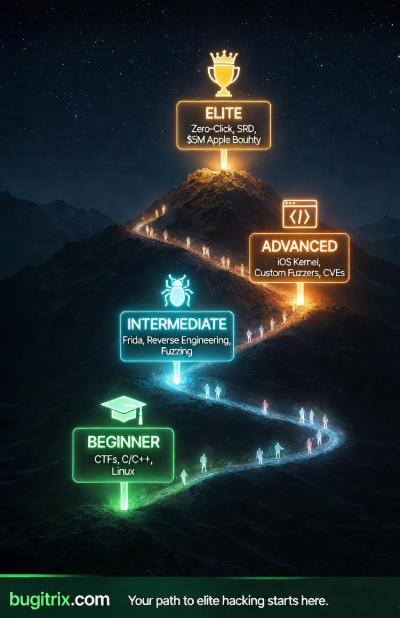
Here's a concrete roadmap for different experience levels:
If You're a Beginner:
- Learn C and understand memory management deeply
- Study operating system fundamentals — processes, memory, file systems
- Complete CTF challenges on platforms like picoCTF, HackTheBox, and CTFtime
- Get comfortable with Linux before tackling Apple platforms
- Start reading: "The Art of Exploitation" by Jon Erickson
If You're Intermediate:
- Start reverse engineering iOS apps with Frida and objection
- Read Apple's security platform documentation in full
- Study published iOS CVEs and their writeups on Project Zero's blog
- Practice fuzzing with open-source targets before tackling Apple frameworks
- Join a CTF team that focuses on binary exploitation
If You're Advanced:
- Apply for the Security Research Device Program
- Begin studying XNU kernel source code (available on Apple's GitHub)
- Read Phrack and Project Zero writeups on iOS internals
- Start fuzzing specific Apple attack surfaces with custom tooling
- Build a private research blog — your public research history matters for SRD applications
🗺️ Your roadmap is ready — download it now. The Bugitrix Apple Bug Bounty PDF includes your complete Beginner → Advanced checklist, the top 10 learning resources with direct links, and the full skill pyramid — everything on this page, packaged and printable. ⬇ Download the Free Career Roadmap PDF
Bugitrix_Apple_BugBounty_Guide.pdf
No signup needed. Just download and start.
One Final Thought
The same iPhone sitting in your pocket right now is one of the most secure computing devices ever mass-produced. The people finding vulnerabilities in it are operating at the absolute frontier of technical knowledge.
Apple pays $5 million for those bugs because finding them requires extraordinary skill — and because the alternative is someone selling them to a government for $30 million to use against journalists, dissidents, and activists.
Ethical hackers who responsibly disclose these vulnerabilities make the world genuinely safer. The bounty is Apple's way of competing with the darker market for these discoveries.
That's not just a career. That's a mission worth pursuing.
🚀 Ready to Build Your Bug Bounty Career?
The knowledge is out there. The programs are open. The payouts are real. What separates the researchers earning from the ones watching from the sidelines is consistent learning, community, and mentorship.
Here's how to take your next step right now:
📚 Explore More Guides & Tutorials Everything from beginner recon techniques to advanced exploit development — all in one place. 👉 bugitrix.com — Your cybersecurity learning hub
📲 Get Daily Cybersecurity Tips, News & Tricks Stay sharp with fresh content every single day — vulnerabilities, tools, techniques, and industry news delivered directly to your feed. 👉 t.me/bugitrix — Join the Bugitrix Telegram Channel
🤝 Join a Community of Hackers Like You Ask questions, share writeups, get feedback on your research, and grow alongside others who are on the same path. 👉 bugitrix.com/forum/help-1 — Join the Bugitrix Community Forum
🎓 Apply for 1-on-1 Mentorship Want a structured path with guidance from experienced professionals? Our mentorship program pairs you with people who've been exactly where you are. 👉 Apply for Mentorship — Limited spots available
📄 Build a Resume That Gets You Hired Your skills need to be visible. We help you build a cybersecurity resume that stands out to recruiters, bug bounty platforms, and security teams. 👉 Build Your Resume With Us — Fill out the form and let's build it together
🚀 Take This Guide With You
You just read one of the most detailed Apple bug bounty breakdowns on the internet. Now make it actionable.
Download the free Bugitrix PDF — includes everything from this blog in one beautifully designed file:
✅ Full $5M payout table with severity tiers ✅ Beginner → Advanced career checklists ✅ Top 10 resources with direct links ✅ Program comparison table ✅ Submission checklist for every report
⬇ Download Free PDF Guide — bugitrix.com
Bugitrix_Apple_BugBounty_Guide.pdf
Apple's Security Research program is open. The SRD applications are live. The $5 million is sitting there for whoever finds the right bug first.
The question is whether you'll be the one who finds it.