
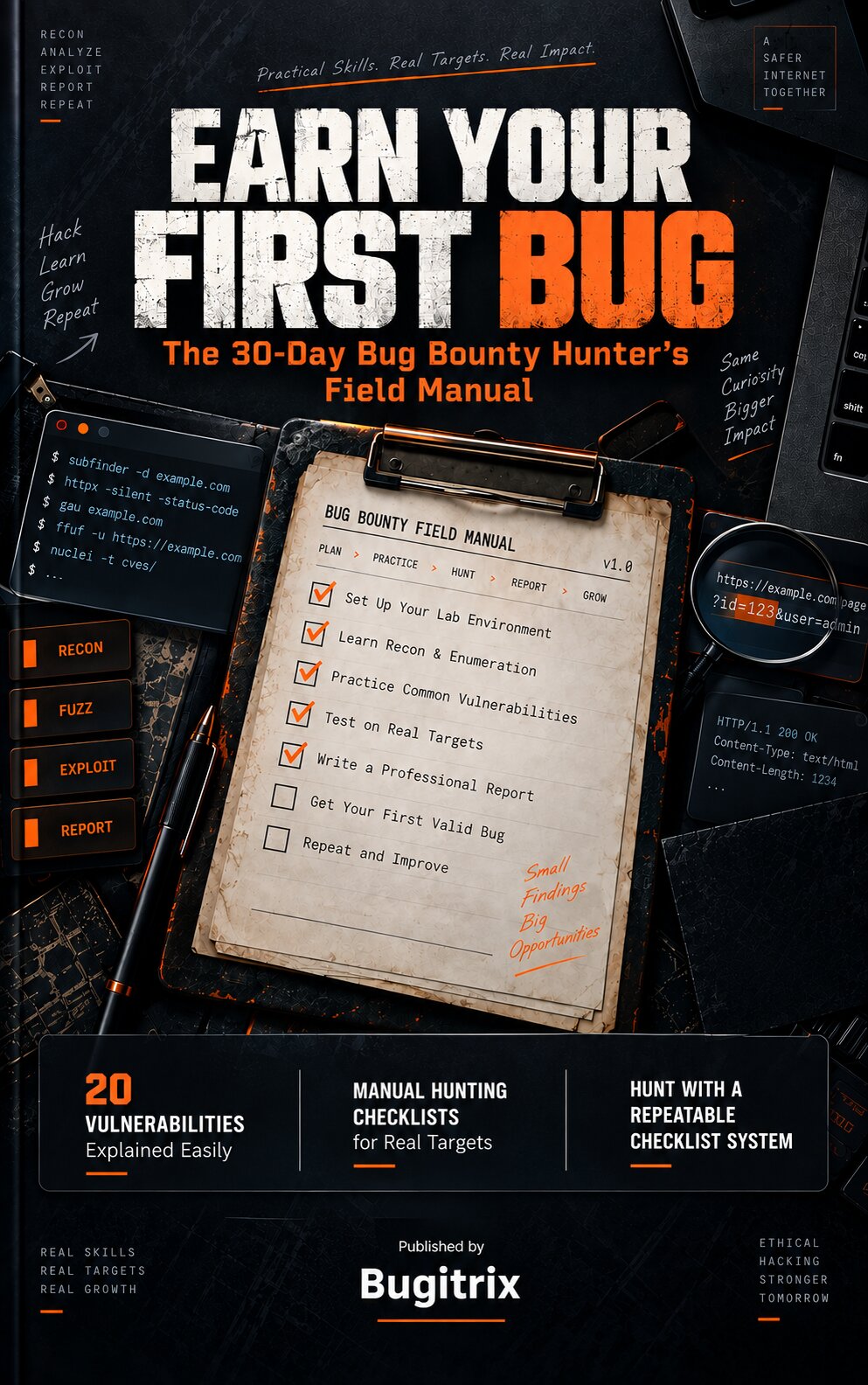
Every year, thousands of people decide they want to get into bug bounty hunting. They watch a few YouTube videos, install Burp Suite, pick a random target on HackerOne, and then… nothing. No valid findings. No bounty. Just hours of aimless clicking and a growing sense that maybe hacking really is only for a select few geniuses.
That's not a talent problem. It's a methodology problem — and it's exactly the gap that Earn Your First Valid Bug in 30 Days, published by Bugitrix, was written to close.
This isn't a theory-heavy cybersecurity textbook. It's a 145-page, hands-on field manual built around one goal: taking someone with zero security background and walking them, checklist by checklist, toward submitting a real, triager-ready vulnerability report — in 30 days, using tools that cost nothing.
Get the book here: https://www.amazon.in/dp/B0HL461MRC
Why Most Beginners Fail at Bug Bounty Hunting
There's a specific reason so many aspiring bug bounty hunters quit before finding their first valid bug: they're taught vulnerability theory without ever being handed a repeatable process for finding that vulnerability on a live, real-world target.
Knowing that "SQL injection happens when user input isn't sanitized" doesn't tell you where to look on an actual website, what parameter to test first, what payload to try, or how to tell the difference between a real finding and a false positive. This book fixes that by giving every single vulnerability class the same rigorous treatment: what it is, where to find it, exactly how to test for it, and how to prove it safely.
The 5-Step Vulnerability Blueprint
Starting from Chapter 3, every vulnerability chapter in the book follows the same structure, so once you understand the format, you can apply it to any new target:
- What is this Vulnerability? — A plain-English explanation with a real-world analogy.
- Types & Variants — How the flaw actually shows up in modern apps.
- Where to Look? — Specific features, endpoints, and parameters worth targeting.
- Step-by-Step Finding Checklist — The exact actions to take, using free tools.
- Remediation & Authorization Guidelines — How developers fix it, and where the ethical line sits during testing.
This consistency is what makes the book usable as a field reference, not just a one-time read. You can flip open the SSRF chapter mid-hunt, follow the checklist, and move on.
What's Inside: 22 Chapters, 20 Vulnerability Classes
The book opens with the essentials every hunter needs before touching a target — the hacker mindset, the legal boundaries of scope, and a full walkthrough of setting up a completely free testing environment (Burp Suite Community Edition, Firefox with FoxyProxy, and command-line tools like httpx, ffuf, and nmap).
From there, it moves into 20 dedicated vulnerability chapters, covering the exact bug classes that dominate real-world HackerOne, Bugcrowd, and Intigriti submissions:
- Reconnaissance & Information Disclosure — Exposed sensitive files and source code leakage, hardcoded secrets and API keys in JavaScript, open directories, public cloud storage misconfigurations, and verbose error/stack trace leakage
- Client-Side Vulnerabilities — Open redirects, HTML injection and content spoofing, Reflected XSS, Stored XSS, and clickjacking (UI redress)
- Authorization Flaws — Insecure Direct Object Reference (IDOR), Broken Object Level Authorization (BOLA/API IDOR), and missing function-level access control (horizontal and vertical privilege escalation)
- Request-Forgery & Configuration Issues — Cross-Site Request Forgery (CSRF), CORS misconfigurations, business logic flaws and parameter tampering
- Server-Side Exploitation — File upload vulnerabilities, rate limiting and brute-force bypasses, SQL injection (in-band, blind, and out-of-band), and Server-Side Request Forgery (SSRF), including cloud metadata extraction from AWS, GCP, and DigitalOcean
Every chapter includes concrete, copy-and-adapt technical detail — not vague advice. The IDOR chapter walks you through setting up dual test accounts and executing an authorization swap test. The SSRF chapter shows the exact metadata endpoint URLs for AWS EC2, GCP, and DigitalOcean, plus real bypass techniques (decimal/hex/octal IP encoding, DNS redirection, HTTP redirect chaining) for when a target blocks the obvious 127.0.0.1 request. The CSRF chapter separates GET-based, POST-based, and JSON/API-based forgery, with full proof-of-concept construction for each.
The 30-Day Game Plan
Instead of leaving you to figure out pacing on your own, the book maps out a full 30-day schedule:
| Days | Focus |
|---|---|
| 1–3 | Foundation & environment setup |
| 4–10 | Recon and low-hanging fruit |
| 11–18 | Client-side and session bugs |
| 19–25 | Authorization and business logic bugs |
| 26–30 | Server-side exploitation |
This structure matters more than it might seem. Recon-based bugs (exposed files, misconfigured buckets, leaked secrets) tend to be the easiest wins for a beginner, so the roadmap deliberately front-loads them to build confidence before moving into harder authorization and server-side classes like SQLi and SSRF.
Built Entirely on Free Tools
There's no upsell hidden inside this book. Every technique relies on tools that cost nothing:
- Burp Suite Community Edition for intercepting and modifying HTTP traffic
- Chrome DevTools and Firefox with FoxyProxy for client-side inspection
- ffuf for directory and parameter fuzzing
- httpx for HTTP probing
- nmap for network reconnaissance
- Google Dorking techniques for surfacing exposed files and misconfigured assets through search alone
If you've been holding off on bug bounty hunting because you assumed you needed a paid toolkit, this book removes that excuse entirely.
Ethics and Authorization Are Baked Into Every Chapter
One of the more responsible design choices in this book is that it never separates "how to find the bug" from "how to stay within legal and ethical bounds." Every single vulnerability chapter ends with an Ethical & Scope Boundaries section specific to that flaw — for example, in the SSRF chapter, explicit guidance not to use extracted cloud credentials to actually access internal resources, and to stop testing the moment impact is proven. This isn't generic disclaimer language; it's flaw-specific guidance on where the line between "valid proof-of-concept" and "unauthorized access" actually sits.
Who This Book Is Actually For
- Absolute beginners who want a structured 30-day path instead of scattered tutorials and forum threads
- Developers, sysadmins, and IT professionals who want to understand how their own applications get attacked, from the attacker's perspective
- Aspiring bug bounty hunters who've dabbled in recon but never converted a finding into a submitted, valid report
Final Thoughts
The gap between "knows what SQL injection is" and "found a valid SQL injection and got paid for it" is entirely made of process — knowing where to look, what to test in what order, how far to push a proof-of-concept, and how to document it so a triager takes it seriously. Earn Your First Valid Bug in 30 Days hands you that exact process, vulnerability by vulnerability, day by day.
If you've been stuck between wanting to start bug bounty hunting and actually knowing how, this is the structured, actionable starting point.
Get your copy here: https://www.amazon.in/dp/B0HL461MRC