
Introduction
You have been learning cybersecurity. You have watched tutorials, maybe completed a few courses, and you understand what a firewall does. But here is the problem: you still do not know how to turn that knowledge into actual money or real-world experience.
Bug bounty hunting offers a path. It lets you practice ethical hacking on real systems, build a public track record, and potentially earn rewards. But most beginners get lost because they try to learn everything at once.
This guide gives you a clear bug bounty roadmap. It shows you exactly what to learn, in what order, and how to go from cybersecurity student to someone who actually finds and reports bugs.
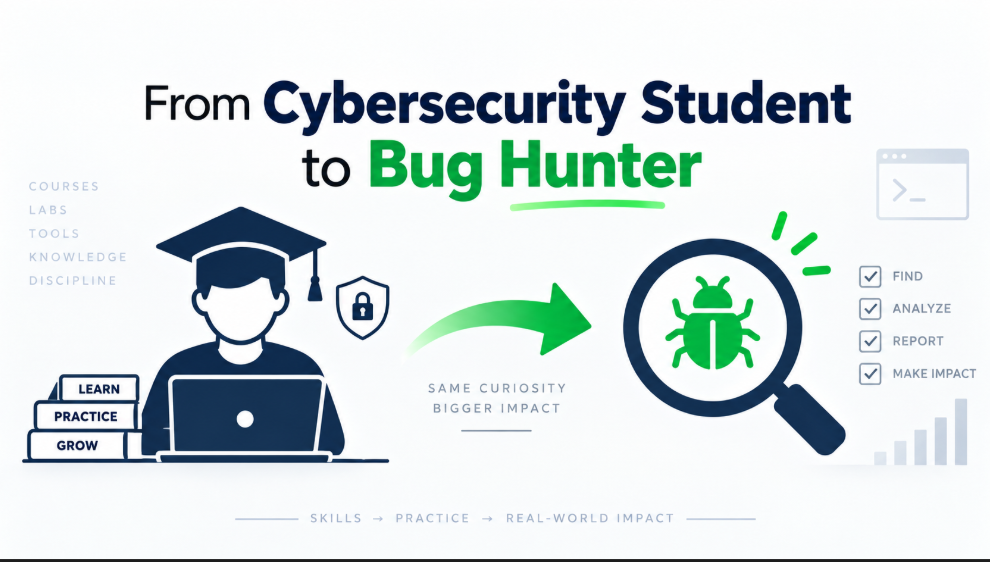
What Is Bug Bounty Hunting (Explained Simply)
A bug bounty program is a deal between a company and security researchers. The company says: “If you find a security flaw in our system and report it to us responsibly, we will pay you.”
That is it. No interviews. No degree required. Just skill.
Companies like Google, Microsoft, and GitHub all run these programs. They pay anywhere from $50 to over $100,000 depending on how serious the bug is . Some researchers earn a full-time income from this work.
But here is the honest truth: bug bounty is not a get-rich-quick scheme. Most beginners earn zero for months before their first payout . The ones who succeed treat it as a skill-building process, not a lottery ticket.
Why Bug Bounty Is a Smart First Step for Students
You might wonder: why not just apply for internships?
Three reasons make bug bounty valuable for students:
1. No gatekeeping. Companies do not care if you have a degree or certifications. They care if you can find real bugs. Your HackerOne or Bugcrowd profile becomes your resume.
2. You build proof of work. Every resolved report is public evidence of your ability. A student with three valid bug reports has more credibility than one with zero.
3. The learning is practical. Labs teach you concepts. Bug bounty teaches you how real systems break, how companies handle reports, and how to communicate findings like a professional.
The Bug Bounty Roadmap: From Zero to First Report
Phase 1: Build Your Foundation (Weeks 1-6)
You cannot hack what you do not understand. Before touching any bug bounty platform, learn these basics:
Networking fundamentals:
How HTTP requests and responses work
What DNS, IP addresses, and ports are
The difference between TCP and UDP
Web technologies:
HTML, CSS, and JavaScript basics
How cookies and sessions work
What APIs are and how they communicate
Linux command line:
Navigating the file system
Basic commands like grep, awk, and curl
Setting up a virtual machine with Kali Linux
Free resources like TryHackMe and Cisco NetAcad can get you through this phase without spending money .
Phase 2: Learn the OWASP Top 10 (Weeks 7-12)
The OWASP Top 10 is a list of the most common web security vulnerabilities. Almost every bug you find as a beginner will fall into one of these categories.
Focus on understanding these three first:
Cross-Site Scripting (XSS): When a website lets attackers inject malicious JavaScript that runs in other users’ browsers.
Insecure Direct Object Reference (IDOR): When you can access someone else’s data by changing a number in the URL.
Cross-Site Request Forgery (CSRF): When a malicious site tricks a logged-in user into performing an unwanted action.
PortSwigger Web Security Academy offers free, hands-on labs for all of these. Complete them until the concepts feel natural.
Phase 3: Practice in Safe Environments (Weeks 13-18)
Before testing real companies, you need repetitions in labs.
Use these platforms:
PortSwigger Academy: The best free resource for web vulnerability labs
TryHackMe: Beginner-friendly rooms that walk you through concepts
Hack The Box: More challenging, but great for building problem-solving skills
The goal here is not to memorize payloads. It is to understand why vulnerabilities exist and how to identify them in different contexts.
Phase 4: Start Hunting on Real Programs (Weeks 19+)
Now you are ready to look at real bug bounty programs.
Step 1: Sign up on platforms.
Create accounts on HackerOne and Bugcrowd. Both are free .
Step 2: Choose the right programs.
Do not start with Google or Facebook. Instead, look for:
Programs with wide scope (example: *.company.com)
Programs with fast response times
Programs that accept beginner-friendly bug types like XSS and IDOR
Step 3: Read the policy carefully.
Every program has rules about what you can test and what you cannot. Violating scope can get you banned. Read the entire policy before touching anything .
Step 4: Start with manual testing.
Automated scanners have their place, but they will not find the bugs that pay. Spend time understanding the application. Click through every feature. Ask yourself: “What happens if I change this input? What if I access this endpoint without permission?”
Step 5: Submit your first report.
Even if it is a low-severity finding, submitting a well-written report teaches you the process. Your first report will probably not be perfect. That is fine. The goal is to finish, not to be flawless.
Common Mistakes Beginners Make
Chasing duplicates. You spend four hours finding a bug, submit it, and get “Duplicate” as a response. This happens constantly . The fix: avoid extremely popular targets when starting. Choose less competitive programs.
Ignoring the scope document. Getting banned from a platform because you tested an out-of-scope asset is worse than finding zero bugs. Read the rules first.
Writing vague reports. “I found XSS” is not a report. A good report includes: exact steps to reproduce, a clear proof of concept, and a specific description of the impact .
Quitting after zero payouts. Most successful hunters had a long stretch of unpaid work before their first bounty. Treat early submissions as paid (in experience) training.
Key Takeaways
Bug bounty is a skill-based path. No degree or certification required, but consistent practice is mandatory.
Start with foundations. Networking, web technologies, and the OWASP Top 10 come before any hunting.
Labs build repetition. PortSwigger, TryHackMe, and Hack The Box are your training grounds.
Choose beginner-friendly programs. Wide scope, fast response, and common bug types give you the best odds.
Report quality matters. A clear, reproducible report gets paid faster and more fairly.
Expect a slow start. Most beginners earn nothing for months. Consistency separates those who succeed from those who quit .
FAQ
Do I need certifications to start bug bounty hunting?
No. Platforms like HackerOne and Bugcrowd do not require certifications. Your profile and report history matter more than credentials.
How long before I earn my first bounty?
It varies. Some find a bug in their first month. Many spend six months or longer before their first payout . The key is to keep learning from each attempt.
What is the easiest bug type for beginners?
XSS (Cross-Site Scripting) and IDOR (Insecure Direct Object Reference) are common beginner findings. They appear frequently and do not require advanced exploitation skills.
Can I do bug bounty from India?
Yes. Bug bounty is location-independent. Platforms pay internationally, and many Indian researchers earn significant income from programs .
How much time should I dedicate each week?
Even 5-10 focused hours per week can produce results over time. Consistency matters more than marathon sessions.
Further Reading / Resources
PortSwigger Web Security Academy — Free labs for all OWASP Top 10 vulnerabilities
HackerOne Hacktivity — Public disclosed reports to learn from real examples
OWASP Testing Guide — Comprehensive methodology for web application testing
TryHackMe — Beginner-friendly cybersecurity training paths
Bugcrowd University — Free educational content on bug bounty methodology
🎯 Action
Ready to stop guessing and start building your cybersecurity career?
At Bugitrix, we help beginners get a clear roadmap, real skills, and job-ready confidence through 1:1 mentorship.
👉 Book your 1:1 Cyber Security Mentorship — Click here to apply
👉 Get your Resume & LinkedIn Optimized — Click here to apply
Have questions? Reach us at Info@bugitrix.com or visit bugitrix.com