
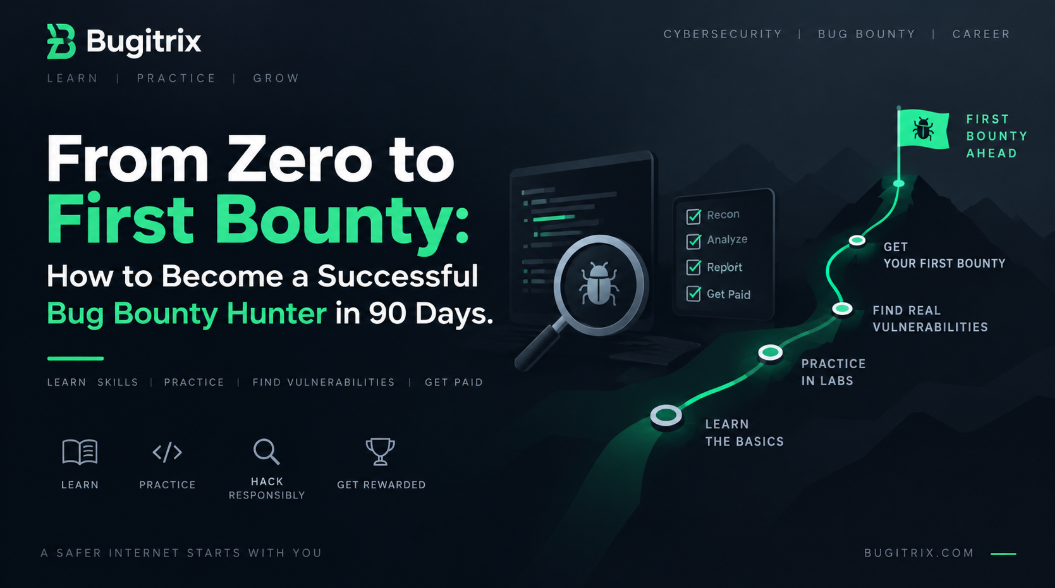
From Zero to First Bounty: How to Become a Successful Bug Bounty Hunter in 90 Days
No CS degree. No "hacker gene." Just a plan, consistency, and 90 days of doing the work most people give up on by day 10.
Let me tell you the truth nobody puts in the clickbait thumbnails: most people who start bug bounty hunting quit within the first three weeks.
Not because they're not smart enough. Not because hacking is some mystical skill reserved for hoodie-wearing geniuses in dark rooms. They quit because they go in without a roadmap — bouncing between YouTube videos, random Hack The Box machines, and a Twitter feed full of people posting $10,000 bounty screenshots, feeling more lost every day.
Here's the thing: bug bounty hunting is a learnable, systematic skill. It rewards structure more than raw talent. If you give it 90 focused days — not 90 lazy days, 90 real days — you can go from "I don't know what a request header is" to submitting your first valid, paid report.
This is that roadmap. No fluff. No "just learn everything" advice. A week-by-week plan you can actually follow.
Why 90 Days? (And Why Most People Never Get There)
Ninety days is long enough to build real competence, short enough to stay motivated with a visible finish line. It breaks down into three clean phases:
- Days 1–30: Foundation — understanding how the web actually works
- Days 31–60: Offense — learning to find and exploit real vulnerabilities
- Days 61–90: Execution — hunting on real programs and submitting real reports
The reason most beginners fail isn't lack of intelligence — it's skipping Phase 1 and jumping straight to "let me find an XSS on this random website" without understanding what's happening under the hood. That's like trying to pick a lock before you know how locks work. You'll get lucky once, then hit a wall.
Phase 1: Foundation (Days 1–30) — Learn How the Web Actually Works
You cannot break what you don't understand. This phase is unglamorous, and that's exactly why most beginners rush through it. Don't.
Week 1–2: Core Web Concepts
- HTTP/HTTPS: requests, responses, headers, status codes, cookies
- How a browser talks to a server (DNS resolution, TCP handshake, TLS)
- Client-side vs. server-side — what runs where, and why it matters
- Get comfortable with Burp Suite Community Edition — this will be your best friend for the next 90 days and beyond
Week 3: Learn to Read Code (Even a Little)
- Basic HTML, JavaScript, and enough Python to write simple scripts
- Understand how forms submit data, how APIs work, what JSON looks like
- You don't need to be a developer — you need to read code like a detective reads a crime scene
Week 4: The OWASP Top 10, Properly
Don't just memorize the names. Understand why each vulnerability exists:
- Broken Access Control
- Injection (SQLi, Command Injection)
- Cross-Site Scripting (XSS)
- Security Misconfiguration
- Insecure Design
- For each one, build a tiny vulnerable app locally (or use DVWA / OWASP Juice Shop) and break it yourself
Milestone by Day 30: You should be able to explain, in your own words, how a login page works from click to database query — and name three ways it could go wrong.
Phase 2: Offense (Days 31–60) — Learn to Actually Find Bugs
This is where it gets fun. You're no longer studying theory — you're hunting for real weaknesses in safe, legal environments.
Week 5–6: Practice on Purpose-Built Labs
- PortSwigger's Web Security Academy (free, and genuinely one of the best resources in existence)
- Work through every lab on: SQL Injection, XSS, CSRF, SSRF, IDOR, Authentication flaws
- Don't just complete labs — write a one-paragraph explanation of why each vulnerability worked, in your own words
Week 7: Reconnaissance — The Skill Nobody Talks About Enough
- Learn subdomain enumeration (subfinder, amass)
- Learn to map an attack surface: what technologies is a site running, what endpoints exist, what's exposed
- Recon is 70% of real-world bug hunting. Most beginners skip this and wonder why they never find anything
Week 8: Specialize in 2–3 Vulnerability Classes Don't try to master everything at once. Pick your early focus areas — good starter choices:
- IDOR (Insecure Direct Object References) — high frequency, beginner-friendly
- Broken Access Control — huge payout potential, logic-based (no fancy tools needed)
- XSS — well-documented, lots of practice material available
Milestone by Day 60: You've completed at least 50 PortSwigger labs and can find at least one class of vulnerability (like IDOR) confidently, without hints.
Phase 3: Execution (Days 61–90) — Hunt for Real, Submit for Real
This is where theory turns into income and reputation.
Week 9: Pick Your Platforms and Programs
- Start on HackerOne and Bugcrowd — look for programs marked "beginner-friendly" or with a wide scope
- Avoid heavily-picked-over programs (like major tech giants) at first — go for newer or smaller-scope programs where competition is lower
Week 10: Build Your Hunting Workflow
- Recon → Map the attack surface → Test systematically against your chosen vulnerability classes → Document everything as you go
- Keep detailed notes — screenshots, requests/responses, timestamps. This will save you hours when writing reports
Week 11: Write Your First Report (Even If You're Not 100% Sure)
- A great bug report includes: clear title, step-by-step reproduction, impact explanation, and a suggested fix
- Quality of communication matters almost as much as the finding itself. A well-written medium-severity report often gets triaged faster and paid better than a messy critical one
- Submit it. Yes, even if you're nervous. You learn more from one real submission than 10 more labs
Week 12: Iterate, Learn From Rejections, and Keep Going
- Not every report gets accepted — that's normal, even for experienced hunters
- Read the triage feedback carefully. It's free mentorship from the platform's security team
- Adjust, refine your recon, and submit again
Milestone by Day 90: You've submitted at least 3–5 real reports on live programs — regardless of outcome. You now have the actual process down, which is worth more than any single payout.
What Nobody Tells You About the First 90 Days
- You will feel behind. Everyone does. Even hunters earning six figures started exactly where you are.
- Duplicate reports are part of the game, not a sign you're bad. Someone finding the same bug first doesn't mean your process was wrong.
- Consistency beats intensity. Two focused hours a day for 90 days will outperform a burnout weekend of 12-hour grinding followed by two weeks of nothing.
- Community accelerates everything. Join Discord servers, follow write-ups on Medium and Twitter/X, and study disclosed reports on HackerOne's Hacktivity — reading how others found bugs is one of the fastest ways to level up your own pattern recognition.
Your 90-Day Roadmap at a Glance
| Phase | Days | Focus |
|---|---|---|
| Foundation | 1–30 | HTTP, Burp Suite, basic coding, OWASP Top 10 |
| Offense | 31–60 | PortSwigger labs, recon, specialize in 2–3 bug classes |
| Execution | 61–90 | Real programs, real recon, real reports, real feedback |
Print this out. Pin it above your desk. Cross off each week as you complete it. Momentum is the entire game.
You Don't Have to Figure This Out Alone
Ninety days of self-study is absolutely possible — thousands of hunters have done it. But it's also the hardest way to do it, because you're guessing at what to prioritize, what "good enough" looks like, and where you're wasting time.
That's exactly why Bugitrix exists.
🎯 Want a mentor to shortcut your learning curve? Get 1:1 Cybersecurity Mentorship — personalized guidance from someone who's already walked this path, so you skip the trial-and-error and focus on what actually moves the needle. 👉 Book your mentorship session
📄 Ready to turn your new skills into a job or client? Get your Resume & LinkedIn Optimized for cybersecurity and bug bounty roles — built to get noticed by recruiters and hiring managers. 👉 Optimize your Resume & LinkedIn
📢 Want daily tips, write-ups, and a community that's grinding alongside you? Join the Bugitrix Telegram for resources, motivation, and real talk from people on the same journey. 👉 Join us on Telegram
Ninety days from today, you can either be exactly where you are now — or you can have your first bounty, your first real report, and a skill that compounds for the rest of your career.
The roadmap is right here. The only variable left is you.
— Team Bugitrix